Preparedness Hub
Multi-Pet Emergency Planning
By EmergencyPetPrep Editorial · Updated
Short answer: To evacuate with several animals, multiply supplies, carriers and documents per animal rather than per household, and write a per-pet destination roster. Ready.gov and the ASPCA list a carrier "ideally one for each pet", and the ASPCA recommends 7 to 10 days of food and at least 7 days of water per pet. No authority publishes a grab-order priority for which pet goes first.
Researched and written with AI assistance from the published sources listed at the end of this page. We are not veterinarians, no veterinarian has reviewed this page, and we do not test products by hand, so check those sources and talk to your own vet about your animal. How we work →
Key takeaways
- Ready.gov and the ASPCA both list a traveling bag, crate or sturdy carrier "ideally one for each pet", and AVMA says to have a carrier for each pet. Humane World for Animals sets a size rule for carriers but publishes no per-pet count.
- None of the six authorities cited here publishes a grab-order or triage priority for which pet to evacuate first. The sources that address it say to take pets with you. Our framework for the rare case where you cannot is labeled as ours.
- Run supply math per animal, not per household. The ASPCA recommends 7 to 10 days of food and at least 7 days of water per pet; Humane World for Animals sets a 5-day-per-pet floor. Plan to the higher number if you can.
- Assemble documents per pet, not per household, and write a per-animal destination roster with a duplicate records-and-authority set for each destination. In a mixed-species household, one destination may take the dog and not the parrot.
- A planned split is ordinary. In one self-selected survey of 352 Australian owners, 21 percent planned to keep some pets with them and take others elsewhere. That is stated intent in Australia, not US behavior.
Want it on paper? Get the free printable go-bag checklist.
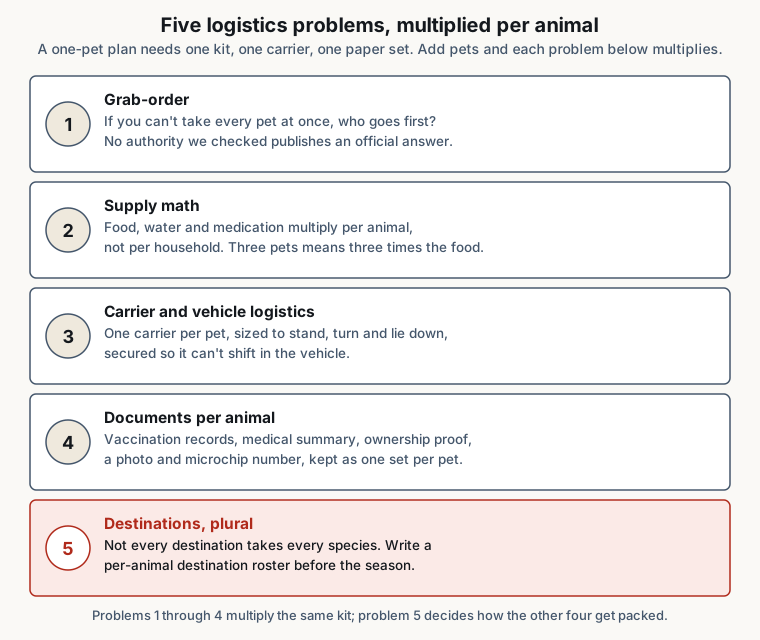
In a household with more than one dog, cat or other animal, the emergency plan cannot be a single-pet checklist scaled up. Supplies, carriers and documents multiply per animal, and each animal needs a named destination. Five logistics problems come with that: grab-order, supply math, carriers and vehicle space, documents per pet, and split destinations.
Want this on paper? The printable pet emergency plan turns the logistics below into a one-page fill-in you can keep with your go-bag.
Multi-pet households are common
A single-pet checklist does not cover the extra logistics of several animals, and many households have several. The American Pet Products Association’s 2025 Dog & Cat Report shows a multi-cat trend in its own data: single-cat households fell from 64% in 2018 to 58% in 2024, two-cat households rose 8% over the same period, and households with three or more cats grew 36%.
That data covers cats only, but it shows more households with several animals to move.
The five problems single-pet guides skip
A one-dog household needs one kit, one carrier, one set of papers and one decision about when to leave. Each of those becomes a math problem with a second or third animal:
- Grab-order. If you truly cannot move every pet in one trip, who goes first, and who decides?
- Supply math. Food, water and medication multiply per animal, not per household.
- Carriers and vehicle logistics. How many carriers fit in your car, and how do you load and secure them?
- Documents per animal. Vaccination records, ownership proof and medical notes must exist separately for each pet.
- Destinations, plural. Which animal goes where, and what happens if the household itself leaves in two directions?
Problems 1 through 4 each have a deep-dive guide linked below. Problem 5 is covered here, because it decides how the other four get packed.
Problem 1: Grab-order, when you can’t take everyone at once
None of Ready.gov, the ASPCA, AVMA (its pets-and-disasters page and its Save the Whole Family guide), the CDC, Humane World for Animals or the American Red Cross publishes an official grab-order or triage priority for which household pet to evacuate first. Ready.gov, the ASPCA, Humane World for Animals and the American Red Cross each say not to leave pets behind when you evacuate. That is the right default, and preparing ahead makes it achievable. The Red Cross adds a limit on its pet fire safety page: never delay escape or endanger yourself or family to rescue a family pet.
The guidance goes quiet on the harder case: a fast-moving wildfire, a flash flood, or a medical emergency of your own in which you genuinely cannot move every animal in one trip. For that case we built a practical framework, labeled as EmergencyPetPrep’s reasoning and not an agency rule. See which pet to evacuate first.
Ready.gov’s buddy system is the better tool for most households: arrange in advance for a neighbor, friend or relative who can evacuate or care for your pets if you are unavailable when the order comes. That turns a one-person, multi-animal problem into a shared one. In an apartment building the strongest version is reciprocal; our apartment building pet buddy system checklist covers who to pick, the access to arrange and the walk-through that makes it work.
Problem 2: Supply math, multiplied per animal
The authorities do not fully agree on the numbers:
| Source | Food per pet | Water per pet | Medication |
|---|---|---|---|
| ASPCA | 7–10 days, rotated every ~2 months | At least 7 days, bottled | 2-week supply, waterproof container |
| Humane World for Animals | At least 5 days (baseline minimum) | At least 5 days (baseline minimum) | No supply length given |
Sources: ASPCA Disaster Preparedness; Humane World for Animals Pet Disaster Preparedness.
The math is straight multiplication, not a shared pool. Three cats at the ASPCA’s 7-day floor is 21 cat-days of food and 21 cat-days of water. If budget or storage forces a choice, plan to the higher ASPCA numbers and treat Humane World’s 5 days as the absolute floor.
Medication is the sharpest per-animal problem. The ASPCA lists a two-week supply of any medicine your pet requires, kept in a waterproof container with medical records. Our suggestion, not the ASPCA’s: keep a separate labeled supply for each animal, so a shelter or pet-sitter knows which medication goes with which animal. A fillable pet sitter emergency instructions sheet keeps that straight, with a per-pet feeding and medication block and the emergency vet already written down. The full worksheet is at multi-pet go-bag math.
Problem 3: Carriers and vehicle logistics
Ready.gov and the ASPCA both list a traveling bag, crate or sturdy carrier “ideally one for each pet”, and the ASPCA adds that each should be labeled with the pet’s name and your contact information. AVMA is the most specific: “Have a collapsible cage or airline-approved carrier for each pet.” Its reason is that having enough carriers is what makes a fast evacuation possible, and it also tells owners to practice evacuating with all pets and supplies before a real emergency. Humane World for Animals sets a size standard rather than a count: “Carriers should be large enough to allow your pet to stand comfortably, turn around and lie down.” It adds that the pet may have to stay in the carrier for hours.
Our reasoning, not a cited finding: a panicked or injured animal can bite, scratch or bolt during a chaotic evacuation, and a properly sized, familiar carrier helps keep you from getting hurt while you help.
Vehicle loading is where published guidance thins out. None of the preparedness authorities cited here says how many carriers fit safely in a vehicle or how to secure them. The Center for Pet Safety publishes its own independent crash-test results. Our best available guidance is at loading carriers for multiple pets and evacuating multiple cats, since a cat that hides or bolts adds its own handling problems.
Problem 4: Documents per animal, not per household
Across the ASPCA, AVMA and CDC, the recurring document set is:
- Vaccination and rabies records
- Medical summary and current prescriptions
- Proof of ownership or registration
- A recent photo of the pet, ideally with you in the frame, for proof of ownership if you are separated
- Microchip number
- Written notes on feeding schedule, medical conditions and behavior issues
AVMA says to keep the evacuation kit, which includes important documents, in a waterproof container close to an exit. The CDC’s version adds recent test results to the medical summary. Ready.gov stresses that a microchip only helps if the registry contact information is current, so check it now.
The mistake multi-pet households make most is keeping one folder for “the pets” instead of one complete set per animal. A shelter, boarding kennel or emergency vet handling three of your animals needs to pull one pet’s records without sorting through all three. If a boarder or daycare is part of your routine, our pet daycare emergency intake checklist covers the per-pet information that facility needs at drop-off. Setup guides: waterproof pet document kits and the pet emergency binder.
Problem 5: Two destinations and a split household
The first four problems assume every animal is going to the same place and the household leaves together. Two things break that assumption.
The animals don’t all qualify for the same destination. AVMA’s Save the Whole Family guide says: “Locate and pre-arrange an evacuation site outside the impacted area.” It warns that many human shelters do not accept pets and that temporary disaster animal shelters are not ideal for most pets, to be considered only after you have explored all other sheltering options. Its position is that a temporary disaster animal shelter belongs at the end of your list.
A second species thins the list again. A co-located pet shelter that takes dogs and cats may not take a parrot, a snake or a rabbit. Do pet-friendly disaster shelters exist covers what those facilities accept, and the state pet shelter policy finder points you to your own state’s published rule. Humane World for Animals advises asking each hotel about restrictions on number, size and species; see pet-friendly hotel evacuation. A boarding kennel may take the dog and decline the reptile. An aquarium is a different problem entirely: see transporting fish during a hurricane evacuation and aquariums and reptiles in a power outage. Horses and livestock need their own destination: horse and livestock evacuation basics. Backyard chickens are their own case: backyard chicken emergency evacuation.
The people don’t all leave from the same place. One adult may be at work when the order comes, which is its own guide: an evacuation order while you’re at work. Two drivers may take two vehicles because three carriers and a crate don’t fit in one: how many pets fit in one car. One person may stay behind to shut off gas or move furniture. Any of these turns one evacuation into two, and the failure is quiet: each adult assumes the other grabbed the cat.
How often do owners plan to split the animals up?
One survey puts a number on it. Melanie Taylor, Erin Lynch, Penelope Burns and Greg Eustace surveyed 352 Australian pet owners who had lived through a disaster or local emergency and published the results in the Australian Journal of Emergency Management (Volume 30, No. 2, April 2015). The article reports that 74 per cent of owners planned to keep all their pets with them when they evacuated, 21 per cent planned to keep some with them and take others to a different location, and one per cent did not plan to take their pets.
Read those figures with their limits:
- It is Australian data. The respondents came from all Australian states and territories, and the paper notes that Australia has no equivalent of the US Pets Evacuation and Transportation Standards Act 2006. It shows the shape of the problem, not a US rate.
- The sample was self-selected. Respondents were recruited through social media and other media. The authors write: “The sampling strategy for the study was uncontrolled and self-selected, which can result in biases and cannot be considered representative of all pet owners.”
- The data are from 2013. Fieldwork ran from 22 January to 22 March 2013.
- It measures planning, not behavior. For what owners did, the article reports that most of those who evacuated kept some of their pets with them (81 per cent) and 15 per cent left some pets behind.
What we take from it, as our reasoning and not the authors’: about a fifth of a self-selected group of Australian owners expected to send some animals somewhere else. That is enough to show that a two-destination evacuation is an ordinary arrangement to plan for. It cannot tell an American reader how likely they are to face one.
What a two-destination plan needs
-
A per-animal destination roster, written before the season. One line per animal: the animal, where it is going, the named person there, and a phone number that reaches them. Humane World for Animals supplies raw material: make a list of boarding facilities and veterinary offices that might shelter animals, with their 24-hour telephone numbers; contact hotels and motels outside your immediate area to ask if they accept pets; and “call ahead for a reservation as soon as you think you might have to leave your home.” The call belongs to the stretch where you are still deciding. The printable pet emergency plan gives the roster somewhere to live.
-
Records travel with the animal. If the dog boards and the cats ride with you, the dog’s vaccination proof must be in the dog’s carrier, because the folder in your glove box is now in a different county. Waterproof pet document kits and the pet emergency binder both cover splitting the set per animal.
-
Duplicate the authority, don’t hand it off. AVMA gives three instructions: include a signed veterinary medical treatment authorization in your evacuation kit, which helps your veterinarian provide care if your pet must be treated while you are away; designate a friend or neighbor to care for your pets if a disaster occurs when you are not at home; and give that person a signed letter that releases them from responsibility if a pet is injured during an evacuation and tells them where your evacuation kit is. Two destinations mean two signed sets. One original that leaves with whichever animal you loaded first is the same as no authorization at the other address. The pet evacuation kits hub carries the full records-and-authority branch, and the emergency boarding checklist covers what the receiving facility asks to see.
-
One named person confirms each animal, out loud. A better document doesn’t close the assumption gap. Someone reading each animal’s name off the roster and getting a spoken answer for that animal before either vehicle moves does. Which pet to evacuate first covers the order; this step confirms the order happened.
-
A reunification plan for the household. AVMA says: “Be ready to reunite in case you are separated from your pet.” That means proper identification and up-to-date microchip and other ID information. A split household is planning two reunions: the animals with each other, and every animal with whoever holds its paperwork. If an animal goes missing partway through, finding a lost pet after a disaster is the method.
-
A caution about the likely destination. Sending two cats to a relative who already has cats is the common answer. AVMA advises keeping animals from different households separated as much as possible during evacuation and while away from home, to decrease stress and the risk of disease transmission. Budget a separate room, bowls and litter box on arrival. Humane World’s pre-arrangement advice is to find a trusted neighbor, friend or family member and give them a key, which is what makes the nobody-is-home version of this plan work.
The decision upstream of all six is whether to split at all. Board your pet or evacuate together walks the case for keeping every animal with you against boarding some outside the zone, and shelter in place or evacuate is the step before that. If your helper is a neighbor in the same building, see the apartment building pet buddy system; splitting supply costs with neighbors covers what is genuinely shareable across households.
Get the exact list for your household
The pet emergency kit builder assembles a checklist filtered to your household and hazard. If you want the arithmetic already run, multi-pet go-bag math includes three worked shopping lists covering both the 72-hour go-bag window and the 2-week CDC shelter-in-place window:
- 2 cats (10 lb each) + 1 dog (50 lb): roughly 1.64 gallons of water and 1.3-3 lb of food for 72 hours; roughly 7.66 gallons of water and 6.2-14 lb of food for 2 weeks.
- 2 dogs (25 lb and 60 lb) + 2 cats (9 lb and 12 lb): roughly 2.48 gallons of water and 2.5-5.6 lb of food for 72 hours; roughly 11.59 gallons of water and 11.7-26 lb of food for 2 weeks.
- 1 dog (35 lb) + 1 cat (10 lb) + 1 rabbit: roughly 1.05 gallons of water and 1.17-2.57 lb of food (dog and cat combined) for 72 hours, plus the rabbit’s House Rabbit Society-sourced hay, pellet and water allotment; roughly 4.92 gallons of water and 5.44-12 lb of food (dog and cat combined) for 2 weeks, plus double that rabbit allotment.
Each example also lists carrier picks sized to that household’s animals and the litter or bedding math that applies. If your pets differ, the page shows the per-pound and per-cup formulas so you can run your own numbers.
The two-kit system
Ready.gov recommends two separate kits: a larger kit for sheltering in place and a lighter grab-and-go version for evacuation. In a multi-pet household this matters more. A shelter-in-place kit can hold bulk food and a full first-aid kit per animal, but an evacuation kit has to be light enough for one person to carry alongside carriers and pets. Build both, and store the evacuation version where you can grab it in under a minute.
Small apartments and tight storage
“One carrier per pet” and “at least 7 days of water per pet” are the right numbers, but they collide with a closet that is already full. Start with which carriers collapse:
| Carrier/crate | Collapses for storage? | Collapsed or folded size (manufacturer page) |
|---|---|---|
| Mirapet Collapsible Pet Crate (Medium) | Yes | 26”L x 15.3”W x 5.5”H (the manufacturer lists a 5.5-inch collapsed height for each size; check the listing for yours) |
| Sleepypod Atom | Folds flat | 17”L x 10.5”W x 2.5”H (assembled: 17”L x 8.5”W x 10.5”H) |
Rigid hard-sided kennels do not collapse, so budget their full assembled footprint as permanent floor space. If floor space is your binding constraint, a fold-flat carrier that stores 2.5 to 5.5 inches tall does work a rigid kennel can’t. If crash protection matters more, a rigid kennel may win; see vehicle loading for multiple pets, and check the Center for Pet Safety’s test results for whichever carrier you consider.
How to run the storage math. Multiply length by width by height for each item, add the volumes, and compare the total to your actual space before you buy anything. For example, two Sleepypod Atom carriers, one per cat, stored assembled at the manufacturer’s 17 x 8.5 x 10.5 inch size come to about 2 x 1,517 = 3,035 cubic inches. Add the dimensions printed on the listing for each water and food container you plan to buy, and measure your closet shelf: any shelf figure here would be an assumption. The worked household examples show the same per-animal multiplication for other households.
Under-bed and closet-shelf realities. Measure your under-bed gap first. The Mirapet’s 5.5-inch collapsed height and the Atom’s 2.5-inch folded height are the thinnest figures in the table, and a rigid kennel doesn’t belong under a bed. Put stackable water and food containers on a closet floor or shelf where you can reach them without pulling out a bed frame’s worth of gear during an evacuation.
Apartment buildings add an evacuation-route problem. The U.S. Fire Administration, a FEMA agency, says not to use elevators during a fire, since they may become disabled or be secured by first responders. Its guidance is to “Quickly and safely proceed to the nearest stair exit and close any doors behind you,” close the stair or corridor doors so smoke and fire do not fill the stairwell, and continue down to the ground floor and fully exit the building. With a carrier in each hand, practice your actual stairwell route, not the elevator you use every other day.
For a resident who genuinely cannot self-evacuate down a stairwell, the USFA’s guidance is to call 911 and be prepared to shelter in place in an individual room with the door closed, using a wet towel to seal the cracks around the door. Factor your pets’ carriers into whichever version of that plan applies before an emergency forces the choice.
The American Red Cross covers acclimation on two pages. Its pet fire safety page says that when you practice your escape plan, practice taking your pets with you and train them to come when called. Its pet disaster preparedness page says to include pets in evacuation drills so they get used to entering and traveling in carriers calmly. With a real stairwell descent between you and the street, that drill matters more than it does in a single-story house.
If something goes wrong: poisoning
A multi-pet household has a second reason to move fast on a suspected poisoning: working out which animal got into something, and whether others are at risk. If you suspect any pet ingested something toxic, call the ASPCA Animal Poison Control Center at (888) 426-4435, available 24 hours a day, 365 days a year. A consultation fee may apply. Do not wait to see whether symptoms appear in a second pet before calling. For heat-related emergencies, see pet heatstroke emergency response for named-authority thresholds on when to go straight to the emergency vet.
Every guide in this section
Grouped by the part of a multi-pet plan each belongs to.
Grab-order and getting everyone out
- Which pet to evacuate first: no authority publishes a grab order, so this lays out EmergencyPetPrep’s own framework, built from sourced facts and labeled as ours.
- Evacuating with multiple cats: a capture order, pre-staged carriers and a room-by-room sweep for cats that hide and bolt.
- Can two cats share a carrier?: usually no, even for bonded pairs, with the vet-backed reasons and the rare exceptions.
Supply math and splitting costs
- Multi-pet go-bag math: per-animal food, water, medication and litter math, with worked household examples and a bag-weight reality check.
- Splitting supply costs with neighbors: which parts of pet disaster prep are shareable across households, and the buddy plan the split creates.
Vehicles, wagons and moving on foot
- Vehicle loading and restraints: AVMA rules, Center for Pet Safety crash ratings, carrier anchoring, cargo heat and loading order.
- How many pets fit in one car: cargo dimensions against crate footprints for sedans, SUVs and minivans, plus seatbelt and stacking limits.
- Pet wagon for multiple dogs: weight capacity, tie-in points so a panicked dog cannot bail, and where a wagon stops working.
- Two-vehicle evacuation convoy: allocating the household across two cars, pairing each animal with its own medication, a records copy per vehicle, and staying in contact if the cars separate.
Records, authority and handing pets off
These guides travel with an animal to a second address, so they are the working set for Problem 5 as well as Problem 4.
- Pet emergency binder: a per-animal binder of medical records, microchip details, boarding notes and consent to treat, with printable templates.
- Daycare emergency intake checklist: the emergency information a daycare or boarder needs, plus questions about its own fire and evacuation plan.
- Foster pet emergency checklist: the rescue’s vet-care rule in writing, a temporary ID tag and a fast starter kit.
Large dogs and long-distance moves
- Giant breed disaster kit logistics: per-day water and food math for a 100 to 150 lb dog, giant-crate vehicle space and a two-person injured-dog lift.
- Moving long distance with pets: vet records, CVI timing, microchip updates and per-species transport rules, sourced from AVMA, ASPCA, AAHA and APHIS.
Start this week
The best thing a multi-pet household can do this week: confirm every pet’s microchip registry contact information is current, and run one full evacuation drill (every pet, every carrier, every kit, out the door) so the first time is not during an actual emergency. The second takes a notepad rather than a purchase: write the destination roster, one line per animal, naming where it goes, who is there and the number that reaches them. The Problem 5 section above carries the roster, the duplicate authority set and the confirmation step; the decision that precedes it is at board your pet or evacuate together, and destination research starts at do pet-friendly disaster shelters exist.
Frequently asked questions
What is a multi-pet emergency plan and why do multiple pets change disaster prep?
It is a household plan built on the fact that supplies, carriers, documents and evacuation logistics multiply per animal instead of once per household. A single-pet checklist assumes one carrier, one set of records and one animal to move. Add a second dog or a third cat and you are solving five problems at once: grab-order, supply math, carriers and vehicle space, per-pet documents, and where each animal is actually going.
How much food and water do you need per pet in an emergency kit?
The ASPCA recommends 7 to 10 days of food per pet, rotated about every two months, and at least 7 days of bottled water per pet. Humane World for Animals sets a lower baseline of at least 5 days of food and water per pet. Calculate per animal: three pets means three times the food, not one large bag split three ways. Plan to the higher ASPCA numbers if budget and storage allow.
Do I need a separate carrier for each pet during an evacuation?
Ideally, yes. Ready.gov and the ASPCA both list a carrier "ideally one for each pet", and the ASPCA adds that each should carry the pet's name and your contact information. AVMA says to have a collapsible cage or airline-approved carrier for each pet, because enough carriers is what makes a fast evacuation possible. Humane World for Animals gives a size rule: room to stand, turn around and lie down.
What documents do I need for each pet in a disaster?
Vaccination and rabies records, a medical summary with current prescriptions, proof of ownership or registration, a recent photo of the pet (ideally with you in it), the microchip number, and notes on feeding, medical conditions and behavior. Keep one complete set per pet, because a shelter, boarder or emergency vet may process each animal separately. AVMA says to keep the evacuation kit, which includes important documents, in a waterproof container close to an exit.
Which pet should you evacuate first if you can't take them all at once?
No authority publishes a priority order. None of Ready.gov, the ASPCA, AVMA, the CDC, Humane World for Animals or the American Red Cross does. Ready.gov, the ASPCA, Humane World and the Red Cross each say not to leave pets behind when you evacuate. For the rare case where you truly cannot move everyone in one trip, our own framework is at the which-pet-first guide. It is our reasoning, not an agency rule.
What if my pets can't all go to the same place, or two people evacuate separately?
Treat it as a planned split. Write a per-animal roster (animal, destination, named person, working phone number), give each destination its own copy of the records and signed treatment authorization, and name one person who confirms each animal out loud, by name, before either vehicle moves. AVMA also says to designate a friend or neighbor to care for pets when nobody is home.
Free checklist
Get the printable pet go-bag checklist by email
A one-page, print-ready go-bag checklist grouped by Ready.gov, ASPCA, AVMA, CDC and Red Cross categories, with a link to the full guide for per-animal quantities. One email to confirm it's you, then the checklist, the binder templates and occasional new guides. Unsubscribe any time.
Sources
We are not veterinarians, and we would rather you check these than take our word for anything. These are the sources this page relies on. For your own animal, your vet is the expert, not this page.
- Ready.gov, Prepare Your Pets for Disasters (opens in a new tab)
- ASPCA, Disaster Preparedness (opens in a new tab)
- ASPCA, Animal Poison Control Center (opens in a new tab)
- American Veterinary Medical Association, Pets and Disasters (opens in a new tab)
- AVMA, Save the Whole Family: Disaster preparedness for households with pets (PDF) (opens in a new tab)
- Humane World for Animals, Pet Disaster Preparedness (opens in a new tab)
- CDC Healthy Pets, Build a Pet Disaster Preparedness Kit (opens in a new tab)
- American Pet Products Association, 2025 Dog & Cat Report press release (multi-cat household figures) (opens in a new tab)
- Australian Journal of Emergency Management, April 2015 (Taylor, Lynch, Burns and Eustace), The preparedness and evacuation behaviour of pet owners in emergencies and natural disasters (opens in a new tab)
- Australian Journal of Emergency Management, Vol 30 No 2, April 2015, full article PDF (source of the survey figures) (opens in a new tab)
- Center for Pet Safety, Test Results (opens in a new tab)
- U.S. Fire Administration (FEMA), Protecting people who live or work in high-rises (opens in a new tab)
- American Red Cross, Pet fire safety (opens in a new tab)
- American Red Cross, Pet Disaster Preparedness & Recovery (opens in a new tab)
- Mirapet, Collapsible Pet Crate product page (collapsed dimensions) (opens in a new tab)
- Sleepypod, Atom product page (carrier and folded dimensions) (opens in a new tab)
More guides in this hub
- Evacuating to Family Who Already Have Pets: Separation, the Vaccination Conversation, and the Exit Trigger
- Evacuation Vehicle Load Planner: Payload, Loading Order, and How Many Trips You Actually Get
- One Room, Incompatible Animals: Partitioning a Hotel Room When Your Own Pets Cannot Share It
- Pet Insurance vs a Pet Emergency Fund
- Reuniting Cats After an Evacuation Separation: When They Come Home and Act Like Strangers
Related reading
Multi-Pet Planning
Which Pet Do You Evacuate First? The Grab-Order Framework
Checklist
Multi-Pet Go-Bag Math: How Much Food, Water, and Meds Per Animal
How-To
Vehicle Loading & Restraints for Multiple Pets: Crash-Tested Carriers, Anchoring, and Loading Order
How-To
Evacuating With Multiple Cats
How-To
Rabbit & Small Pet Emergency Preparedness
Multi-Pet Planning
How Many Pets Fit in One Car During an Evacuation? The Real Cargo Math
Explainer
Can Two Cats Share a Carrier During an Evacuation?
Shared Prep
Splitting Pet Emergency Supply Costs With Neighbors
Checklist
Foster Pet Emergency Checklist