We use Google Analytics to see which guides actually help people, so we know what to write next. It is the only thing here that measures you, and declining costs you nothing on this site.What we collect.
Your browser sends a Global Privacy Control signal, and we honor it. Analytics is already off for you, so there is nothing here to change.
Short answer: Build two kits: a larger one to shelter in place and a lighter go-bag to evacuate with, each covering food, water, medicine, documents, a carrier, and sanitation supplies. Ready.gov says several days of food and water, AVMA 3-7 days of food and at least 7 days of water, the ASPCA 7-10 days of food, and the CDC 2 weeks per animal. Build the go-bag to the shorter figure and the shelter-in-place kit to the longer.
EmergencyPetPrep is reader-supported: links on this page may earn us a commission. As an Amazon Associate I earn from qualifying purchases. We don't sell products or take sponsorships, and commissions never touch how picks are ranked. How we choose →
Researched and written with AI assistance from the published sources listed at the end of this page. We are not veterinarians, no veterinarian has reviewed this page, and we do not test products by hand, so check those sources and talk to your own vet about your animal. How we work →
Key takeaways
•Ready.gov's core guidance is two kits: a larger one for sheltering in place, and a lighter grab-and-go version for evacuation. Review both regularly. Ready.gov, the ASPCA, AVMA, the CDC and the Red Cross all organize the kit around the same core categories.
•Duration guidance is not one number. Ready.gov says several days, AVMA 3-7 days of food, the ASPCA 7-10 days, the CDC 2 weeks; the Red Cross gives no day count. Build the go-bag to the shorter figure and the shelter-in-place kit to the longer.
•Records are not authority. Waterproof and duplicate the documents, then add what AVMA recommends separately: a signed veterinary medical treatment authorization, a designated friend or neighbor, and a signed letter releasing that person from responsibility.
•Federal rules limit stockpiling controlled-substance medication. Schedule III or IV prescriptions cannot be refilled more than five times or six months after issue, and Schedule II cannot be refilled. Ask your veterinarian how large a reserve they will authorize.
•A microchip helps only if the registry contact information is current. Ready.gov and AVMA both say to keep it up to date; the ASPCA and Red Cross recommend microchipping but do not publish that step. Give it its own line on your rotation checklist.
Build two kits. A larger one stays home for sheltering in place, and a lighter go-bag stays packed for evacuation. Both cover the same six categories: food, water, medicine, documents, a carrier, and sanitation supplies. Ready.gov, the ASPCA, AVMA, the CDC and the Red Cross all organize a pet kit around that core, even where their quantities differ.
A kit is a system, not a bag. It is staged in the right places and checked often enough that nothing in it has quietly expired. Where this hub links to gear, we are reader-supported through disclosed Amazon links, and commissions never touch what is recommended.
This page is the map. It teaches the structure once, so the spoke guides linked throughout and at the bottom can go narrow on species, duration math, records, written authority and the medication clock.
Want a ready-made starting point? Our pre-made kit picks are sorted by household: single cat, large dog, mixed cat-and-dog, and a kit with water purification.
Ready America, Pet Evac Pak, ER (Emergency Ready), and DryFur are trademarks of their respective owners; EmergencyPetPrep is not affiliated with or endorsed by any of them.
The FEMA/Ready.gov Kit Structure, Category by Category
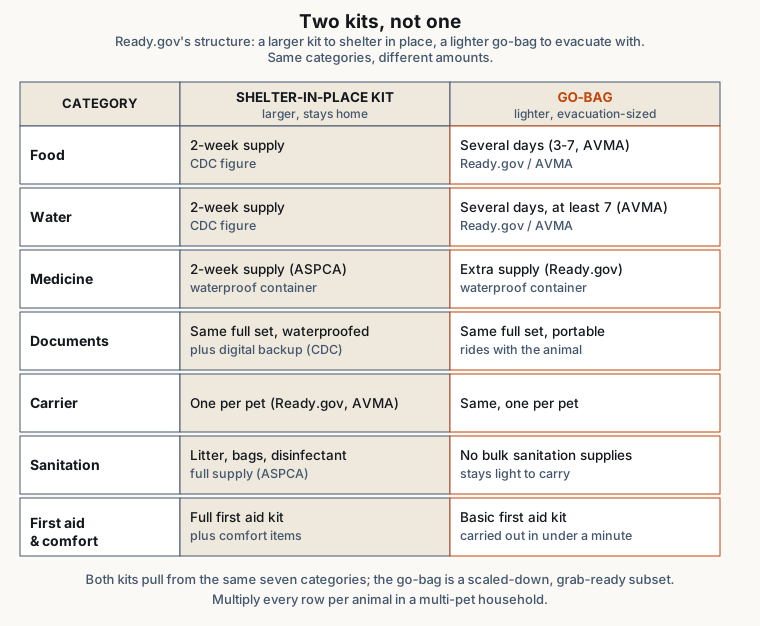
Ready.gov’s framing is the cleanest starting point: build two kits, not one. A larger kit stays home for sheltering in place. A lighter version stays packed and ready to grab for evacuation. Ready.gov says to review both regularly so food and medicine do not go stale. To turn the checklist below into one tailored to your animals and your biggest local hazard, run the pet emergency kit builder; it filters this list to your pets and routes each item to the right calculator or template.
Inside either kit, the categories are consistent across the authorities:
Food: several days’ supply per pet, in an airtight, waterproof container (Ready.gov). The ASPCA and CDC name longer figures (see the table below), and the CDC lists a manual can opener as its own line.
Water: a bowl plus several days’ supply (Ready.gov, which attaches no container specification). The ASPCA adds cool, dry storage and replacement every 2 months (a kit with water purification).
Medicine: an extra supply of any medication your pet takes, in a waterproof container (Ready.gov). The ASPCA, the CDC and AVMA’s kit checklist each specify a 2-week supply. The CDC adds a 1-month supply of flea/tick/heartworm preventive as a separate line.
Documents: vaccination and rabies records, medical summary, prescriptions, proof of ownership, and a recent photo (CDC, AVMA). Waterproof the physical copies; a digital or USB backup is a second layer.
Carrier or crate: one per pet. Ready.gov and the ASPCA publish nearly the same line: a traveling bag, crate or sturdy carrier, ideally one for each pet. AVMA states it without the hedge and gives the reason: enough carriers for each pet is what facilitates a quick evacuation.
Sanitation: disposable litter trays (the ASPCA notes that aluminum roasting pans work), litter or paper toweling, liquid dish soap and disinfectant, and disposable garbage bags.
First aid and comfort items: a basic first aid kit (Ready.gov, AVMA, Red Cross), plus a backup collar, ID tag, harness and leash, and comfort items like a toy or familiar bedding to reduce stress during an already stressful move.
Medication: if any pet takes a regular medication, ask your veterinarian what extra supply and storage make sense for that prescription. This page teaches kit structure, not dosing or treatment decisions; that call belongs to your vet.
How many of everything? The carrier line is per pet, not per household (Ready.gov, ASPCA and AVMA all frame it that way), and food, water, medicine and documents multiply per animal too. A three-pet household is building three of most of this list. The pre-made kits later on this page are each sized for a fixed number of animals, so check the capacity line before assuming one box covers everyone. For the worked per-animal math, see our multi-pet emergency planning hub.
Simplified from the guidance on this page.
Kit vs. Go-Bag: What the Terms Mean
Ready.gov does not use the word go-bag. Its language is simply two kits: one for sheltering in place, one lightweight version for evacuation. On this page, go-bag is our label for the second, lighter kit. It is not an official FEMA term.
On this hub, kit is the larger shelter-in-place build (bulkier food and water, a full first aid kit, sanitation supplies) and go-bag is the lightweight, evacuation-sized version of the same categories, built to be carried out the door in under a minute. The go-bag is a scaled-down, grab-ready subset of the kit, not a different checklist.
How Much Food and Water: Reading the Duration Numbers
The authorities do not agree on one number. Here is the spread:
Source
Food per pet
Water per pet
Framing
Ready.gov
Several days, airtight, waterproof container
Bowl + several days
Go-bag / evacuation framing
AVMA
3-7 days’ worth
At least 7 days’ supply
Evacuation kit, stored near an exit
American Red Cross
No day count on the pet page or its PDF checklist
No day count on the pet page or its PDF checklist
Evacuation framing
ASPCA
7-10 days, rotate every ~2 months
At least 7 days, rotate every ~2 months
Can apply to either kit
CDC
2-week supply
2-week supply
Shelter-in-place framing
Sources: Ready.gov Prepare Your Pets for Disasters; AVMA Pets and Disasters; American Red Cross Pet Disaster Preparedness; ASPCA Disaster Preparedness; CDC Build a Pet Disaster Preparedness Kit.
Read this as two jobs, not five opinions. Ready.gov, AVMA and the Red Cross largely describe the lightweight go-bag: enough to get through the trip and the first stretch afterward. The CDC and ASPCA numbers lean toward the fuller shelter-in-place kit, where storage space is not limited by what you can carry. If you have the budget and shelf space, build your at-home kit to the CDC’s 2-week figure and keep your go-bag to several days.
Where to Stage Each Kit
A kit in the wrong place when the order comes is the same as no kit. AVMA recommends storing the evacuation kit in an easy-to-carry waterproof container near an exit, not in a closet and not in the garage behind the holiday boxes.
For most households, three staging points cover the real scenarios:
Home, near an exit. The full shelter-in-place kit plus the evacuation go-bag, both reachable without digging, per AVMA’s near-an-exit guidance.
Vehicle. A lightweight duplicate of the go-bag essentials (food, water, a spare leash, a copy of key documents) for when you are not home as an order comes, or need supplies mid-evacuation before reaching a shelter. None of these authorities publishes a car-specific standard; this is the same two-kit logic applied to a second location.
Grab point inside the home, by the door you would actually use. Even a fully staged kit does no good if it is not where your feet go first during a fast exit.
Maintenance and Rotation
Ready.gov says to review your kits regularly and names no interval. The ASPCA is more specific on one part: rotate food and water every 2 months so it does not go stale or expire unnoticed.
A common habit, borrowed from the twice-yearly smoke-detector battery reminder, is a full kit review every 6 months: check expiration dates, confirm medications are current (not ones your vet discontinued last spring), verify documents are up to date, and make sure any pet added since the last check has their own carrier and supplies. None of the agencies listed here publishes that 6-month cadence, so treat it as a reminder trigger, not an official rule.
One rotation check is not optional: confirm your pet’s microchip registry contact information is current. Ready.gov’s instruction is to have your pet microchipped and to “keep your address and phone number up-to-date” on it, including contact information for an emergency contact outside your immediate area. AVMA’s is to “Ensure your pet has proper identification and that microchip and other ID information is up to date.” The ASPCA and the Red Cross both recommend microchipping, but neither publishes that follow-up step, which is why it gets its own line here. A chip that was never registered, or is registered with an old phone number, will not reunite you with a lost pet during an evacuation. It belongs on the same 6-month reminder as the physical kit review.
Records, Authority, and Medical Consumables
Every complete pre-made kit listed in the products section handles food, water and basic first aid. None handles the paperwork, and none handles the part of the kit that has a clock running on it. That gap is what gets tested at a shelter intake desk, a boarding counter or an unfamiliar emergency vet.
This branch splits three ways, and the three fail differently:
Records prove who the animal is and what it needs. They fail by being illegible, incomplete, or still at home.
Authority is the written permission that lets somebody else act for the animal when you are not there. It fails by never having been created.
Medical consumables expire, run out, or cannot legally be stockpiled on short notice. They fail on a date.
Keep them separate. A perfect folder of records still leaves an emergency vet unable to treat, and a signed authorization is no help if the medication ran out days ago.
Records: What Proves the Animal Is Yours and What It Needs
Per the CDC’s structure, the document set should include:
Photocopied vet records
Rabies certificate
Vaccination and medical summary
Current prescriptions
Heartworm test results (dogs) or FeLV/FIV test results (cats)
Copies of registration
A written description of the pet
AVMA’s checklist files the same set under important documents and adds four lines owners routinely skip: identification papers including proof of ownership and the microchip number, medical records and medication instructions as separate items, an emergency contact list that names the veterinarian and the pharmacy, and maps of the local area and evacuation routes. On its pets-and-disasters page AVMA says to include addresses and 24-hour contact numbers on that list, if available. Keep the list with the kit itself, not only in a phone that might be dead or lost.
Records also cross a state line differently than you do. If an evacuation takes you into another state, the destination state sets the requirement, and USDA APHIS does not publish a standard interstate health certificate you can print ahead. Our long-distance move guide carries the sourced version, including the instruction to call the destination state’s veterinary office directly.
Authority: Who Can Act for Your Animal When You Are Not There
No pre-made kit sells this, and most households have never assembled it. AVMA names three separate pieces of paper, and they do different jobs:
A signed veterinary medical treatment authorization. AVMA says to consider including one with your evacuation kit, to help your veterinarian provide care if your pet must be treated during your absence.
A designated caregiver. AVMA says to designate a friend or neighbor to care for your pets if a disaster occurs when you are not at home.
A signed release for that caregiver. AVMA says to give that person a letter, signed by you, that releases them from responsibility if a pet is injured during an evacuation and tells them where your evacuation kit is. The release letter is also where the kit’s location gets written down, which makes it the one document that tells a helper where everything else is.
A fourth piece is about telling responders the animal exists. AVMA’s preparedness tip is that before a disaster you can post notices on entrances to your home that detail the number of animals inside, and that apartment residents should make sure their animals are on record with management. That is the rescue alert sticker and the fridge pet alert card; our guide on making sure firefighters know pets are inside covers what a sticker can and cannot do once a crew is working the building.
What this page will not tell you is whether your particular form is enforceable. Which wording a veterinarian will accept, and who may consent to treatment for an animal that is not theirs, sits in state veterinary practice law and varies by state. We do not publish our own reading of any state’s statute. Ask your veterinarian, at a routine appointment, which form they will honor, and take the question to your state veterinary licensing board if you want the rule itself. The pet emergency binder covers the AVMA fields to fill in with your vet, the pet sitter emergency instructions sheet is the short-horizon handoff naming who can approve care this weekend, and the pet guardian directive covers the long-horizon version: who takes the animal if you do not come back.
Authority gets tested at an intake desk, not at your kitchen table. Our emergency boarding checklist covers what a facility asks for and why a written spending limit needs a second named approver. Pet daycare emergency intake covers the same fields for a facility that already has your animal when the order comes. The dog walker emergency card and the holiday sitter plan cover the people holding your key on an ordinary week. The foster pet emergency checklist covers the case where the animal legally belongs to a rescue, whose rule governs the veterinary decision. The vet hospital stay bag covers the handoff where the animal stays and you leave.
Medical Consumables: The Part of the Kit With a Clock on It
Food and water expire slowly and visibly. Medication fails quietly, in three ways.
It expires in the bag. AVMA’s evacuation-kit checklist marks the food and medicine lines, and resolves the asterisk in a footnote: “*These items must be rotated and replaced to ensure they don’t expire”. Our kit rotation checklist covers the cadence and what to check at each interval.
It is not in the bag at all. Anything refrigerated cannot live in a go-bag by the door, and AVMA publishes a fix: if medications must be stored outside the kit because of temperature requirements, such as refrigeration, write down the name of the medication and its location and include that note in the kit. A note in the bag keeps a fast exit from leaving the insulin in the fridge. Insulin cooler cases covers carrying it once it is out, pet medication and refrigeration in a power outage covers the case where the fridge itself is the failure, and our asthma inhaler go-bag guide works the same spare-canister-and-records problem for a cat’s chronic inhaler prescription. Heat-sensitive medication has the mirror problem: a bag staged in a car has a temperature ceiling too, so read the storage line on the label before deciding where the bag lives.
You cannot simply order more the week of the storm. For controlled substances the limit is federal, not a pharmacy’s discretion.
Under 21 CFR 1306.22(a), a Schedule III or IV prescription cannot be filled or refilled more than six months after it was issued, and one authorized to be refilled cannot be refilled more than five times.
Under 21 CFR 1306.12(a), refilling a Schedule II prescription is prohibited.
That is half of 1306.12. Under 1306.12(b)(1), an individual practitioner may issue multiple prescriptions authorizing a total of up to a 90-day supply of a Schedule II controlled substance when conditions are met, including a written earliest fill date on each, the practitioner’s conclusion that this creates no undue risk of diversion or abuse, and permission under state law. Paragraph (b)(2) says nothing in it mandates or encourages a practitioner to prescribe that way, so it is a question for your veterinarian, not an entitlement.
These limits reach veterinarians, because 21 CFR 1300.01 defines an individual practitioner to include a veterinarian.
If any animal in your household takes a controlled substance, how large a buffer you may hold is settled at a routine appointment, not in a phone queue during a warning. Ask which schedule the drug falls in, ask what quantity your veterinarian is willing to write, and write the answer somewhere you will find it. For a drug that is not a controlled substance, the ceiling is whatever your vet will authorize, which is a shorter conversation but still worth having before hurricane season. Our seizure-prone dog kit works this problem in the most detail on the site, including how state emergency-refill rules treat controlled and noncontrolled drugs differently and the gap in whether those rules reach a veterinary prescription at all. The pet medication refill calculator keeps the reorder date from arriving unannounced.
Two consumables get forgotten because owners do not file them as medication. Preventives are the first: AVMA’s checklist puts flea and tick prevention inside the first aid kit, and the CDC’s separate preventive line runs on a monthly calendar that does not pause because you are displaced. The second is everything needed to give a dose: syringes, needles, lancets, test strips, a pill splitter, a sharps container. No pre-made kit on this page includes any of it. Count those per animal, for the same number of days as the doses. Our medical consumables count for an evacuation runs that count item by item.
Pet water bowl, cat collar with toy mouse, cat treats, litter pan, bag of litter, litter scoop, pet wipes, pet ID tag, 3 antiseptic wipes, gauze roll, triple antibiotic ointment packet, nitrile gloves, pet carrier
+Covers nearly every FEMA/Ready.gov category in one purchase: food, water, carrier, sanitation, basic first aid, ID
+Listed 5-year shelf life on food and water reduces rotation frequency versus a DIY kit
+Includes the carrier itself, which several DIY builds skip
Cons
−No documents or records pouch included; you add that separately
−Litter pan and scoop add bulk versus a true lightweight go-bag
−No medication storage guidance included
A solid single-purchase base for the Ready.gov categories a single-cat household needs most, but it stops at 72 hours and skips documents entirely. Pair it with the checklist and document guidance below rather than treating it as complete on its own.
+Purpose-built backpack form factor matches the lightweight-evacuation half of Ready.gov's two-kit model
+Most detailed first-aid contents list of the kits on this page
+Manufacturer publishes a freshness policy (ships within 90 days of manufacture), not just a shelf-life number
Cons
−Premium price position versus assembling a DIY kit from the checklist below
−Sized only for large dogs; multi-pet households need a separate kit per animal (see our multi-pet go-bag math guide)
−No litter or sanitation supplies for households that also have cats
The clearest single-species go-bag here: it is built to be carried, not stored, which is what an evacuation kit needs to be. Large-dog-only households get the most direct value; anyone with a second species needs a separate kit.
+The only kit here that budgets for two species, useful for mixed-species households
+Includes both litter/sanitation for cats and a slip lead for dogs in one bag
+Includes a waterproof ID card holder, partially covering the documents category
Cons
−Weight caps (22 lb cat / 40 lb dog) mean larger dogs aren't covered by this single kit
−Small food quantities (8 oz packages) may not stretch to 72 hours for larger animals without supplementing
−Pet Evac Pak's own site does not link an Amazon listing for this kit, and the Amazon listing title does not name the brand; confirm brand and seller on the live listing before buying
The most practical single option here for a household with one cat and one moderate-sized dog, since it is the only kit that budgets for two species. Households with a large dog or more than two pets still need to add supplies or a second kit. See our best pet emergency kits roundup for how it compares with three single-species alternatives.
+Water-purification tablets included: a supply-extension feature the other kits here don't have
+The listing states its water packaging is US Coast Guard-approved (a listing claim, not an independent test)
+Compact nylon bag format suits staging in a car
Cons
−Single-dog only; multi-dog households need the two-dog version or multiple kits
−No wound-care first aid items listed, thinner medical coverage than the Pet Evac-Pak kit above
−No document or records storage included
Worth a look for the water-purification tablets and the listing's Coast Guard-approved water packaging, neither of which the other kits here list. It is thinner on first aid than the Pet Evac-Pak kit, so a household prioritizing medical coverage over water redundancy should look there first.
+Directly addresses the documents category of the FEMA/CDC kit structure, which the complete kits above largely omit
+Transparent design is airline-inspection-friendly per the listing description
+Low-cost way to waterproof vet records, vaccination proof, and registration copies
Cons
−The Amazon listing may not be current; confirm it is live and matches these specs before buying
−Small interior capacity (9 in x 6.75 in) may not fit a full stapled folder of records for a multi-pet household without folding
−Single-purpose item; it doesn't replace a full kit, only the documents sub-component
The clearest fix for the gap every complete kit above shares: none of them include a real documents solution. Confirm the current listing before buying.
Prices/availability change: levels shown are editorial estimates, not live prices. Links may earn us a commission.
Pre-Made Kits vs. Building Your Own
The products above are purchasable starting points, not the only path. Single cat: Ready America. Large dog: Pet Evac Pak Big Dog. Cat and dog together: Pet Evac Pak Cat & Dog. Our best pet emergency kits roundup has them compared kit by kit. A pre-made kit buys speed and consistency: every category addressed at once, with a stated shelf life on the food and water. It costs you fit: a fixed weight capacity, a fixed species assumption, and usually no real documents solution.
Building your own from the checklist in this hub takes more time up front but lets you size food and water to your pet, add the medications your vet has you managing, and choose a carrier that fits your pet’s crate training. Most households land in between: a pre-made kit as the base, with documents, medication and species-specific gaps filled separately. Our DIY pet go-bag checklist walks through the from-scratch build with quantities shown per animal.
Multi-Pet Households: Multiply, Don’t Share
Every pre-made kit above is sized for a fixed number of animals: most for one pet, one for a cat-and-dog pair. If your household has more animals than the kit is built for, do not stretch one kit across everyone. Food, water, medication and documents scale per animal, not per household, because a shelter or emergency vet processing several pets from one family still needs each animal’s supplies individually.
The kit itself cannot solve one version of this: the animals may not all end up in the same place. A shelter that takes dogs and cats may not take a bird, hotels commonly cap animals per room, and a boarding kennel may accept one species and decline another. The records and the signed authorization then have to be duplicated per destination. Our multi-pet emergency planning hub carries that two-destination branch. A pet that lives at two addresses has a version of this problem that has nothing to do with a disaster: our two-address pet guide covers what to buy twice, what travels with the animal, and what exists only once and has to be located before either household can act.
Species-Specific Gear
The kit structure holds for every species, but the right container differs by animal. For dogs, see best dog go-bags. For cats, carrier choice matters even more, since cats bolt and hide differently under stress: see best cat evacuation carriers.
For a head-to-head look at complete pre-made kits scored against the Ready.gov checklist, see best pet emergency kits.
Food and Water Storage, Long-Term
The duration table shows real disagreement between a several-day go-bag and a 2-week shelter kit. Storing for the longer figure (containers, rotation, keeping it edible and drinkable for weeks) is its own topic. Our long-term pet food and water storage guide reconciles the CDC’s 2-week standard against the ASPCA, Ready.gov and AVMA figures. For the go-bag-scale version, see emergency food and water storage for pets. Once a household is inside a flood or an outage, is pet food safe after a flood or outage covers the FDA-published can-and-pouch procedure and the bleach ratios for cleaning what floodwater touched. A therapeutic or veterinary-diet food adds its own storage ceiling: our prescription diet authorizations, expiry and evacuation guide covers why FDA’s own document never uses the word prescription, and why the real gate at checkout is manufacturer and retailer policy running through one clinic.
If Something Goes Wrong: Poison Exposure
A kit does not prevent every emergency it is built for. If you suspect your pet has ingested something toxic, during an evacuation or at any other time, call the ASPCA Animal Poison Control Center at (888) 426-4435, available 24 hours a day, 365 days a year, staffed by veterinary toxicology experts. A consultation fee may apply.
Pet Poison Helpline’s emergency instructions say not to give any home antidotes and not to induce vomiting without consulting a vet or the helpline, and to call the helpline at 855-764-7661. Call first, then follow the guidance you are given.
Every Guide in This Section
This page teaches the structure once. Below is every guide filed under it, grouped by the part of the kit it covers.
Complete Kits and Budget Builds
Best pet emergency kits: pre-made kits compared against the Ready.gov, ASPCA and AVMA checklists.
The single best thing to do this week, before buying anything: confirm your pet’s microchip registry contact information is current, and check whether your existing kit still has fresh food, current medication and up-to-date documents. Most kit failures are not a missing item; they are an old one nobody rotated.
The second best thing, and the one nearly every household is missing: ask your veterinarian at your next routine appointment for a signed treatment authorization, and ask which schedule any prescription your pet takes falls in. Both answers are free, both take a single visit, and neither is obtainable in the hour you actually need them.
Frequently asked questions
What should be in a pet emergency kit?
Ready.gov's list starts with several days of food in an airtight, waterproof container, a water bowl and several days of water, and an extra supply of any regular medicine in a waterproof container. Add a backup collar with ID tag, a leash or harness, a traveling bag, crate or sturdy carrier (ideally one per pet), comfort items, and a first aid kit. The ASPCA and AVMA add sanitation supplies and documents: vaccination records, medical summary, proof of ownership, and a recent photo.
What is the difference between a pet emergency kit and a pet go-bag?
Ready.gov does not use the word go-bag. It describes two kits: a larger one to shelter in place at home and a lighter one sized for evacuation. Go-bag is not an official term. On this page, kit means the full shelter-in-place setup and go-bag means the evacuation-sized version. A light duplicate in the car covers being away from home when an order comes; no authority here publishes a car-specific standard.
How much food and water should I store for my pet in an emergency?
It depends on the authority and the kit. Ready.gov frames the go-bag around several days of food and water. AVMA's evacuation kit asks for 3-7 days of food and at least 7 days of water. The ASPCA recommends 7-10 days of food and at least 7 days of water, rotated every 2 months. The CDC recommends a 2-week supply of food and water per animal. The Red Cross list has no day count.
How often should I check and rotate my pet's emergency kit?
Ready.gov says to review your kits regularly and does not publish an interval. The ASPCA says to rotate food and water every 2 months. A full kit review every 6 months, like a smoke-detector battery check, is a common habit; none of the agencies listed here publishes it, so treat it as a reminder trigger, not an official rule.
What documents do I need in a pet emergency kit, and who can authorize treatment if I am not there?
The CDC's list calls for photocopied vet records, a rabies certificate, a vaccination and medical summary, current prescriptions, heartworm (dogs) or FeLV/FIV (cats) test results, registration copies, and a written pet description. AVMA adds proof of ownership, the microchip number, and a contact list naming your veterinarian and pharmacy. For care in your absence, AVMA suggests a signed veterinary treatment authorization; ask your veterinarian which form they will honor.
How far ahead can I stock up on my pet's prescription medication?
For controlled substances the ceiling is federal. Under 21 CFR 1306.22, a Schedule III or IV prescription cannot be filled or refilled more than six months after issue, or refilled more than five times. Under 21 CFR 1306.12, refilling a Schedule II prescription is prohibited, but a practitioner may issue multiple prescriptions totaling up to a 90-day supply when conditions are met. Ask your veterinarian which schedule applies and what reserve they will authorize.
Free checklist
Get the printable pet go-bag checklist by email
A one-page, print-ready go-bag checklist grouped by Ready.gov, ASPCA, AVMA, CDC and Red Cross categories, with a link to the full guide for per-animal quantities. One email to confirm it's you, then the checklist, the binder templates and occasional new guides. Unsubscribe any time.
Sources
We are not veterinarians, and we would rather you check these than take our word for anything. These are the sources this page relies on. For your own animal, your vet is the expert, not this page.