Terminology Guide
Evacuation Levels, Warnings and Zones: What Do They Mean for My Pets?
By EmergencyPetPrep Editorial · Updated
Short answer: Numbered levels, warning-versus-order labels, and lettered zones are separate local systems, so learn your own county's terms and move pets at the rung your area names.
Researched and written with AI assistance from the published sources listed at the end of this page. We are not veterinarians, no veterinarian has reviewed this page, and we do not test products by hand, so check those sources and talk to your own vet about your animal. How we work →
Read this first
Some pet emergencies outrun any checklist. If an animal is collapsing, struggling to breathe, or was exposed to something toxic, stop reading and call your veterinarian or the nearest emergency animal hospital now. When officials order an evacuation, go; nothing on this page is worth delaying your own exit. This article is spec-and-evidence analysis of published guidance, not veterinary care for your specific animal. Where your vet's instructions or an official order differ from anything here, they win.
Key takeaways
- These are separate local systems, not one national ladder. Oregon and Washington publish numbered levels, California publishes an Evacuation Warning and Evacuation Order pair, and Florida and coastal Virginia publish lettered zones. Learn your own county's words before the season starts.
- A lettered hurricane zone is a label on your address, not an urgency rating. Florida says Zone A is most vulnerable and most likely to be evacuated first. The letter does not change during a storm, but counties redraw maps between seasons, so re-check yearly.
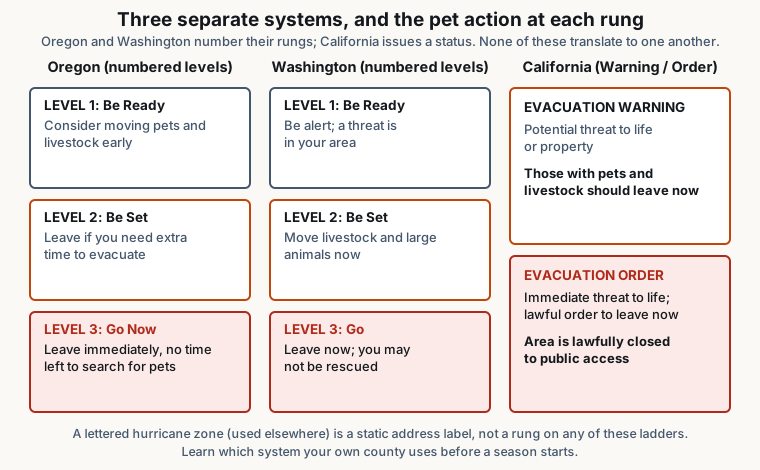
- California's statewide standard names pet owners at the earlier rung. It defines an Evacuation Warning as a potential threat to life and/or property and says those who need extra time, including those with pets and livestock, should leave now.
- Oregon's state wildfire page puts its animal instruction at Level 1, its lowest rung, and says to consider moving pets and livestock early. Washington's page puts its animal instruction at Level 2 and names livestock and large animals. Oregon's Level 3 says leave immediately.
- A National Weather Service Hurricane Warning is a weather forecast, not an evacuation order. Under a storm surge warning, NWS tells readers to check for evacuation orders from local officials.
Evacuation words are set locally, and there is no single national ladder they all sit on. A Level 2 in Oregon, an Evacuation Warning in California and a Zone A address in Florida come from three separate systems that mean different things. Numbered levels and warnings change as a hazard develops. A lettered zone is a label on your street address that does not move during a storm and does nothing until an official names it. For a household with animals, the useful rule is the same wherever there are rungs: do the catching and loading at the earlier rung, because the top rung tells you to leave without gathering anything.
This page decodes the notice you were given and says what a pet household should be doing at each rung. If you are still deciding whether this hazard is a leave-or-stay call, start with our stay-or-go framework for pet households. Each rule below names the jurisdiction it belongs to, and your own county’s emergency management page is the authority for your address.
Three Kinds of Evacuation Notice
Your county publishes one of three things, or a mix. Finding out which takes a few minutes on a calm day, and it does not transfer to the next state over.
The numbered level ladder
Oregon’s state wildfire site says the state follows a three-level notification system, each level built around a readiness need and a threat level. Oregon pairs each level with a title and a map color.
- Level 1, “BE READY to evacuate,” is green on the map. Oregon’s text covers being aware of danger in the area, signing up for county alerts and following local emergency services. It says “This is the time to pack and prepare to leave.”
- Level 2, “BE SET to evacuate,” is yellow on the map. There is significant danger in the area. Be ready to leave at a moment’s notice, and understand that there may not be enough time to pack. Oregon adds that you should leave if you feel unsafe and do not need to wait for another notice.
- Level 3, “GO NOW!,” is red on the map. Leave immediately, because there is extreme danger in the area. Oregon says “Do not stop to gather belongings or make efforts to protect your home.” It also says not to return until officials announce the area is safe.
Washington publishes the same three-rung structure in its own words. The Washington Military Department’s wildfire page describes Level 1 as be ready and be alert, Level 2 as get set to leave at a moment’s notice, and Level 3 as go: leave now, because you are in immediate danger. It adds that even if you cannot see the danger, you should follow your plan and leave, and that if you stay, “you may not be rescued.”
Both ladders read as ready, set, go, which makes them feel portable. The animal instructions inside them sit on different rungs, as the animal section below shows.
The civil status pair
California does not number its rungs. The Governor’s Office of Emergency Services publishes the State of California Alert & Warning Guidelines (Version 2.0, September 2023), with a block of recommended statewide evacuation terminology. Two entries matter most to a resident:
- Evacuation Order: an immediate threat to life. It is a lawful order to leave now, and the area is lawfully closed to public access.
- Evacuation Warning: a potential threat to life and/or property. Those who need extra time, including people with access or functional needs and those with pets and livestock, should leave now.
The Warning is not just a softer Order. It carries an instruction aimed at a named group, and pet owners are in that group by name. For a California household with animals it is the most directly actionable sentence in this guide.
The same document defines Shelter in Place (go indoors, shut and lock doors and windows, and prepare to be self-sufficient until further notice or until emergency personnel contact you), Evacuation Order(s) Lifted (the formal announcement that evacuations in an area are lifted), and three road-closure tiers covered below.
The lettered zone
The third system is not a rung at all, and this is where the confusion turns dangerous. In hurricane country, many counties assign street addresses to evacuation zones and order evacuations by zone. Not every address lands in one. Martin County, Florida says some areas of the county are not in any evacuation zone.
Florida’s Division of Emergency Management, on its Know Your Zone page, says evacuation zones are designated from A to F and that Zone A is generally most vulnerable and most likely to be evacuated first. It says the greatest threat to life from a hurricane is storm surge flooding, and it tells readers to heed the advice and orders of local officials.
Coastal Virginia runs a similar structure with different letters. The Virginia Department of Emergency Management describes a program serving roughly 1.25 million residents of Coastal Virginia, with twenty-three participating localities. Its zones run A through D and tell residents whether to evacuate or shelter at home, “based on their physical street address” and the nature of the emergency. A zone belongs to where you live. It does not tick over as a storm approaches, and it is not an urgency rating.
A Zone Letter Is Not an Urgency Level
A level or a status is a temporary condition attached to an area, and it moves while a hazard develops. A zone letter is a label attached to your address, and it does not move while a hazard develops. They answer different questions.
Pinellas County Emergency Management states the consequence: to know whether you are under an evacuation order, you must know your evacuation zone, which is based on storm surge risk, and those in a zone included in the order must leave. The zone is the lookup key. The order is the instruction.
An Oregon Level 1 does not exist until an incident produces it. Nobody lives at Level 1; an area is placed there and can be raised or lowered. So the thought “I am in Zone A, so that is roughly a Level 1” is wrong on both halves. Florida says Zone A is generally the zone most likely to be evacuated first, and a Level 1 is an active notice that danger is developing. A Zone A household with no order in effect has nothing to do about the letter itself at that moment, but the letter does not tell you how much time you have. That comes from the forecast and from the order.
The letter can change between seasons
Counties redraw zone maps, and an address can change letters without moving. Hillsborough County, Florida announced on May 7, 2026 that its evacuation zones had changed for the 2026 hurricane season and that the zones now affect more properties. The county said NOAA updates its storm surge data or model every three to five years. It said some parcels are now in Zone C that were in Zone D, and some areas that were in no evacuation zone are now in Zone E. It told residents to use its zone lookup to see whether theirs changed.
If you keep animals, the last point matters most. A household that was in no zone last year, wrote that down and has not checked since may now be in a zone that can be ordered out. So the zone letter is stable while a storm approaches, and it can change between seasons. That is why the lookup is an annual job.
The letters differ within one state
As of August 5, 2026, these Florida authorities described their zones differently:
- Florida Division of Emergency Management: the FAQ block on its Know Your Zone page says zones run A to F and that Zone F is most likely to be evacuated last. The map instructions higher on the same page say Zone E is most likely to evacuate last.
- Hillsborough County: five letters, A through E.
- Bay County: four zones, A through D. Zone A is along the water and would typically be the first zone considered for evacuation, and Zone B, C and D would follow depending on the storm scenario and expected surge.
- Martin County: zones identified as AB, CD and E, with some areas in no zone.
A reader who learned the A-to-F range from the state page and then moved to Bay County has learned the wrong count for the new address. A reader looking for a Zone C in Martin County will not find one. Zones are drawn from regional surge modeling for a specific coastline, so the count follows the geography. The only zone alphabet safe to rely on is the one printed on the map that covers your address.
Evacuation zones are not FEMA flood zones
Martin County addresses a second mix-up directly: “Evacuation zones are NOT the same as flood zones, though they are often mistaken for each other.” It says evacuation zones come from the National Hurricane Center and mark areas that storm surge will affect, which officials may order evacuated. Flood zones come from FEMA, show a property’s flood risk at any given time, and are used for flood insurance rates and some building code requirements.
The letter on your flood insurance paperwork is not the letter a county will read out when it orders an evacuation. Look up the evacuation zone separately on your county’s emergency management page and write that one down.
There Is No National Decoder
A single chart translating every state’s terms would be wrong for someone, and the reader it misleads is the one whose county is the exception. Within the level systems, Oregon puts its animal instruction on the lowest rung and Washington puts its own one rung higher. Zone systems have no rung to line up. The National Weather Service uses “warning” for a weather forecast rather than a civil instruction.
FEMA’s Planning Considerations: Evacuation and Shelter-in-Place (July 2019, guidance for state, local, tribal and territorial partners) says the section on zones this way: “The mechanism for assigning zones will vary from jurisdiction to jurisdiction.” The same document warns planners that the public does not use the same terminology as emergency management professionals and may read terms such as mandatory, voluntary, recommended, forced, phased and zoned quite differently than intended.
A crosswalk table would add one more vocabulary to the pile. What helps is knowing which system your county runs and what its own words say. That is a fifteen-minute job on a calm afternoon, with a short re-check each year.
The Pet Action at Each Rung
The instruction at each rung differs in kind, not just intensity, and a task that is easy at one rung is impossible at the next.
If your county publishes numbered levels
At Level 1 the work is confinement and pre-staging, and it is the only rung with unhurried time. Oregon’s Level 1 text tells residents to have their emergency plan and go-kit ready, to plan routes and transportation needs, and includes the line “Consider moving pets and livestock early.” Oregon’s printed flyer repeats that line and adds that people who are older, have children or disabilities, or have limited access to transportation should act early.
For a household with animals, Level 1 is when a cat is still catchable in a calm house with the doors shut, and when an empty carrier can be strapped into the car properly. If one animal disappears when the vacuum comes out, this is your rung. Nothing about the search gets easier later.
At Level 2 the instruction shifts from preparing to being able to leave instantly. Oregon’s text says there may not be enough time to pack and that packing is at your own risk. It says to leave if you or your loved ones cannot move quickly and need extra time, and to leave if you feel unsafe. Oregon’s flyer adds that if you have livestock, you should put your animal evacuation plan into action.
Washington’s Level 2 text has the same shape. It says to have an emergency kit, know your plan and meeting place, consider leaving if you have mobility or medical issues, and “If you have livestock or large animals, move them.”
Read the two Level 2 texts together. Both single out households that are slow. Oregon tells them to leave and Washington tells them to consider it, so the force differs while the targeting is the same. A multi-animal household is a slow household. So is one with a large dog who will not load or a cat who has already gone under the bed.
At Level 3 there is no capture window left. Oregon says emergency responders may not be available to help if you choose to stay, and Washington says “you may not be rescued.” Neither text carves out an exception for finding a hiding animal. The way to avoid that position is to finish confinement two rungs earlier. AVMA states the general rule: “Bring all pets indoors at the first sign of a potential disaster situation so all pets are accounted for if you need to evacuate.”
If an animal is genuinely unreachable at Level 3, our guide to coaxing a hiding cat into a carrier covers fast, safe grabs, and our triage order for multi-animal households covers who goes first when you cannot get everyone.
If your county publishes an Evacuation Warning and Order pair
In California, the statewide standard puts pet owners at the Warning. It says those who need additional time to evacuate, including those with pets and livestock, should leave now. That does not tell a pet owner to be ready. It says leave, at the Warning, alongside everyone else who needs extra time.
Read the status of the document accurately. The Guidelines describe themselves as providing recommendations and expectations for jurisdictions and designated Alerting Authorities. They are language the state urges its jurisdictions to adopt, not a rule every California county must publish.
Los Angeles County’s Ready LA County horses page is blunter about large animals: “Horses should be evacuated as soon as an EVACUATION WARNING is issued. Do not wait for the EVACUATION ORDER.” Our large-animal and trailer playbook covers the loading time behind that advice, and why fire and hurricane decisions run on different clocks. As of August 5, 2026, the same county’s Animal Preparedness page for dogs, cats and other small animals covered supplies, identification and microchip registration, and did not name a rung. For a Californian with dogs and cats, the rung to act on is the one in the statewide terminology above.
At the Evacuation Order, the legal character of the situation changes. California defines it as a lawful order to leave now for an area that is lawfully closed to public access. Any forgotten animal becomes a re-entry problem instead of a five-minute errand. Our page on getting back through a perimeter to an animal you could not reach covers what that costs.
If your county publishes lettered hurricane zones
There is no ladder here and no rung to read. Your zone letter tells you nothing about timing. The timing comes from the county’s evacuation order plus the completion time it announces. Pinellas County says to complete evacuations by the time officials announce, and that “You need to be out of the evacuation areas before winds and/or storm surge arrive.” It adds that the longer you wait, the fewer options you have.
Three practical points follow for an animal household.
Some triggers are not zone triggers. Pinellas says residents of mobile and manufactured homes must always evacuate because of wind risk, and Florida’s emergency management division says people in an ordered evacuation zone, a low-lying flood area or a mobile home should follow all evacuation orders. A manufactured-home household is not waiting to hear its letter read out.
The animal rule at the order is unconditional. Pinellas puts it in one line: “If you are ordered to evacuate, never stay at your home because of your pets. Evacuate and take them with you.”
An order is scoped to zones, so the finish line is a boundary, not a distance. Pinellas tells residents they do not have to go far and can go outside the area ordered to evacuate. It lists a home, business or other building that is not in an ordered zone as a legitimate destination. That decides how much road time a household with four crates in a car is signing up for. If the roads stop moving anyway, our page on managing animals in a stalled evacuation convoy covers heat, water and relief breaks.
For the tier-by-tier timeline once a storm is forecast, see our hurricane season playbook for pet households.
“One Stage Earlier” Is Written Down in Specific Places
Advice to leave one stage before everyone else is good, and agencies have written it down. It is written in specific jurisdictions with specific wording, and those are the versions to rely on.
- California: the statewide standard puts “those with pets and livestock” among the people told to leave now at the Warning stage.
- Los Angeles County: the horses page tells large-animal owners not to wait for the Order.
- Oregon: at Level 1 it says to consider moving pets and livestock early, and at Level 2 it tells anyone needing extra time to leave.
- Washington: at Level 2 it tells owners of livestock and large animals to move them.
- Pinellas County, Florida: the animal line sits at the evacuation order itself, and the county’s pre-storm planning section tells readers to check with hotels for availability and pet policies before any order exists.
None of these says it is a national rule. If your own county’s page carries an animal line, follow it. If it does not, the general principle still holds because catching and loading animals takes time that the top rung does not give you.
You can turn that principle into a number that is yours by timing your own household once, on a calm day, with the animals you have. Our household evacuation drill for pet owners walks through how to run it and what to write down. A household that has timed the run has a real basis for choosing a rung.
Weather Products Are Not Evacuation Instructions
The word “warning” appears in both weather and civil systems and means something different in each.
An NWS Hurricane Warning means hurricane conditions (sustained winds of 74 mph or greater) are expected somewhere within the specified area. NHC issues it 36 hours in advance of tropical storm-force winds to give you time to complete your preparations. A Hurricane Watch means those conditions are possible within your area, and NHC issues watches 48 hours before it anticipates tropical storm-force winds, because it may not be safe to prepare once tropical storm-force winds arrive.
Neither is an evacuation instruction, and NWS says so on the same page: “If you are under a storm surge warning, check for evacuation orders from your local officials.” It also tells readers to listen to instructions from local officials and to evacuate immediately if told to do so.
The National Weather Service forecasts the hazard. Your local government orders the evacuation. A Hurricane Warning and an evacuation order can be in effect at once, and one does not tell you whether the other has been issued.
The trap for a pet owner is specific. In California, “warning” is the earlier civil rung, the one that tells pet owners to leave now. In hurricane terminology, “warning” is the later weather product, issued 36 hours out, when preparations should be complete. The same word sits in opposite positions in the sequence. If you have moved between fire country and the hurricane coast, or read preparedness material written for the other, check which agency issued the notice in front of you.
Words That Are Not Rungs
Shelter in Place. Cal OES defines it as going indoors, shutting and locking doors and windows, and preparing to be self-sufficient until further notice or contact from emergency personnel. It is a protective action, not a lower rung of an evacuation ladder, and for some hazards it is the correct action while an evacuation order is in effect a mile away.
Road closure tiers. For an owner separated from an animal, the closure type matters most. Cal OES’s recommended terminology defines three:
- Hard Closure: closed to all traffic except Fire and Law Enforcement.
- Soft Closure: closed to all traffic except Fire, Law Enforcement and critical incident resources such as utility, Caltrans and city or county roads crews.
- Resident-only Closure: a soft closure that also admits residents and local government agencies assisting with response and recovery.
Only the third contemplates letting a resident through. If your animal is inside the perimeter and the closure is a Cal OES hard closure, the answer to “can I go get my dog” is no, and the productive move is a welfare request instead of a drive to the roadblock.
That list is a recommendation, not a mandate, and some jurisdictions publish a different scheme. The Ventura County Sheriff’s Office of Emergency Services lists two road closures and no resident-only tier. Its Hard Road Closure has law enforcement prevent the general public from entering the area on foot or by vehicle. Its Soft Road Closure keeps the general public out too, and adds: “Those residents who reside in the impacted area will be allowed access with proper identification.”
Put the schemes side by side. On the Cal OES list, a soft closure does not admit you and the resident-only closure does. On Ventura County’s page, the soft closure admits residents with identification. Same state, same two words, opposite answer for the person at the tape with an animal on the other side. An owner who memorized the state list, reads “soft closure” on a county alert and concludes it is hopeless may talk themselves out of an access request that their own county’s published rule would allow.
So the question at a barricade is what your own agency calls this closure, on its own page, and which of its terms admits residents. Find that page on a calm afternoon. Our guide to getting back through a perimeter to an animal you could not reach covers Ventura County’s full terminology and what an access request consists of.
Evacuation Order(s) Lifted. California defines this as the formal announcement of lifting evacuations in an area under evacuation. It ends the order. It is not a certificate that the area is safe for animals: debris, downed lines, contaminated water and damaged fencing can all outlast the order.
Zone status colors. If your county publishes zones through a mapping platform, the color is a status, not a rank. Napa County Emergency describes five statuses on its Genasys Protect map: red for Evacuation Order (evacuate immediately), yellow for Evacuation Warning (prepare for probable evacuation), green for Evacuation Order Lifted (clear to repopulate), blue for Advisory (incident-specific information) and white for Normal (the default day-to-day status). The zone identifier and the zone status are separate fields on the same map, just as a Florida zone letter and a Florida evacuation order are separate things.
Fifteen Minutes of Homework Before the Season
Every system above is easy to read if you did a small piece of homework and nearly impossible to read cold. Do it before a season, put the answers somewhere physical, and redo step 2 every year.
1. Find out which system your county uses. Read your county’s emergency management evacuation page. Look for numbered levels, a warning-and-order pair, lettered zones, or a mix, and write down the exact words it uses. If it uses lettered zones, note how many letters exist, because that number is local. Also find what your agency calls its road closures and which of those terms admits residents with identification.
2. Look up and write down your zone, then redo it every year. Florida’s Division of Emergency Management publishes a statewide zone lookup, and coastal Virginia publishes one for its participating localities. Napa County’s instruction is the model: follow the Genasys Protect link, enter your address and write down your zone. Do this for home and for anywhere your animals spend time without you, such as a daycare, a boarding facility or a relative’s house. Set a calendar reminder for the start of each season, because counties redraw these maps. For a state-by-state view, see our comparison of official alert apps and state zone lookups. If a notice arrives while you are away, see what to do when the notice lands while you are at work.
3. Note where statuses are published. A zone lookup and a live status feed are often two different pages, and the live one matters during an incident. Register for your county’s alert system, because opt-in systems reach only the people who opted in. Our guide to layered alert sources for wildfire status covers how to stack them so no single failure leaves you blind.
4. Write down the rung your household leaves on. Not the rung everyone leaves on. Yours. If your county publishes an animal instruction, that is your rung. If it does not, pick the earlier one and write down why in one sentence, so the tired version of you at two in the morning does not have to re-derive it.
5. Write down what has to be true before you can move. Carriers accessible, animals confined indoors, documents in one place, vehicle loading plan settled. Our guide to securing multiple animals in one vehicle covers restraint, cargo-area heat and anchoring. A rung is only useful if the actions attached to it are already decided.
Put the results on the refrigerator, in the go-bag and in a photo on your phone. One of those lines has a shelf life: re-verify the zone line before each season.
The Short Version
The words on your evacuation notice are local. Levels and warnings change with the hazard. A lettered zone is fixed to your address until the county redraws the map, and what changes during a storm is whether officials order your zone out. NWS watches and warnings are forecasts, not evacuation orders.
For a household with animals, the animal work belongs at the earlier rung, because the later rungs tell you to stop working and go. Oregon says not to stop to gather belongings. California says the order is a lawful order to leave now and the area is closed. Washington says you may not be rescued. None of them leaves room for a search.
For hazard-by-hazard guides that pick up where this page stops, see our pet emergency playbooks hub. If your notice is tied to a nuclear power plant’s emergency planning zone, our evacuating pets from a nuclear emergency planning zone guide covers reception-center mechanics and pre-alert housing that none of the systems above address.
Frequently asked questions
What is the difference between an evacuation level, an evacuation warning and an evacuation zone?
A numbered level (Oregon and Washington) and an Evacuation Warning or Evacuation Order (California's recommended statewide terms) are statuses that change as a hazard develops. A lettered zone, such as Florida's A to F or coastal Virginia's A through D, is a label on your street address based on where surge water is expected to reach. It does not change during an incident; what changes is whether officials order your zone out. Look up which system your county uses, because the vocabulary does not transfer between states.
Does Zone A mean the same thing as a Level 1 evacuation?
No. Zone A describes your address on a calm day in January. Oregon's Level 1 is an active notice for an area during an incident, meaning be ready to evacuate. Florida's emergency management division says Zone A is most vulnerable and most likely to be evacuated first, so Zone A is not the low rung of anything. The trigger in a zone county is an evacuation order that names your zone.
At which stage should I start loading my pets?
Use the rung your own jurisdiction names. California's statewide terms say those who need extra time, including those with pets and livestock, should leave at the Evacuation Warning. Oregon's state wildfire page puts its animal line at Level 1 and Washington's puts livestock and large animals at Level 2. In a lettered-zone county there is no rung to read, so the trigger is the order naming your zone and the completion time the county announces with it.
Is a Hurricane Warning an order to evacuate my pets?
No. NWS says a Hurricane Warning means sustained winds of 74 mph or greater are expected somewhere in the specified area, and that NHC issues it 36 hours before tropical storm-force winds arrive. Evacuation is a separate decision by local officials. Both can be in effect at once, and neither replaces the other.
Is there one chart that translates every state's evacuation terms?
No, and one would be wrong somewhere. FEMA's 2019 planning guidance says the mechanism for assigning zones varies from jurisdiction to jurisdiction. Even inside Florida, Bay County publishes zones A through D and Martin County publishes AB, CD and E. Oregon and Washington put their animal lines on different rungs. Read your own county's page instead.
What does a hard closure or resident-only closure mean, and can I still reach my animals?
Those are road-access terms, not evacuation rungs, and California's list is a recommendation. Cal OES's resident-only closure is the tier that admits residents. Ventura County publishes two closures and no resident-only tier, and its soft closure lets residents in with proper identification. Find what your own agency calls the closure and what that page says it allows.
Free checklist
Get the printable pet go-bag checklist by email
A one-page, print-ready go-bag checklist grouped by Ready.gov, ASPCA, AVMA, CDC and Red Cross categories, with a link to the full guide for per-animal quantities. One email to confirm it's you, then the checklist, the binder templates and occasional new guides. Unsubscribe any time.
Sources
We are not veterinarians, and we would rather you check these than take our word for anything. These are the sources this page relies on. For your own animal, your vet is the expert, not this page.
- State of Oregon, Oregon Wildfire Response and Recovery — Evacuations: Be Ready. Be Set. Go Now! (published by Oregon Department of Emergency Management; the three levels) (opens in a new tab)
- Oregon Department of Emergency Management — Evacuation Levels flyer (PDF, English; created September 2022; the animal lines at Levels 1 and 2) (opens in a new tab)
- Washington Military Department — Wildfire (the three levels of evacuation) (opens in a new tab)
- California Governor's Office of Emergency Services — State of California Alert & Warning Guidelines (PDF; Version 2.0, September 2023; standard statewide evacuation terminology) (opens in a new tab)
- Ventura County Sheriff's Office of Emergency Services — Evacuation Terminology (hard and soft road closures) (opens in a new tab)
- Napa County Emergency — Genasys Protect (Zonehaven), evacuation status levels (opens in a new tab)
- Ready LA County — Horses and Large Animals (Los Angeles County Chief Executive Office / Office of Emergency Management) (opens in a new tab)
- Ready LA County — Animal Preparedness (dogs, cats and other small animals) (opens in a new tab)
- Florida Division of Emergency Management — Know Your Zone, Know Your Home (opens in a new tab)
- Pinellas County, Florida, Emergency Management — Evacuation (opens in a new tab)
- Hillsborough County, Florida — Hillsborough County Expands Evacuation Zones for the 2026 Hurricane Season (news release, May 7, 2026) (opens in a new tab)
- Bay County, Florida — Evacuation Zones (opens in a new tab)
- Martin County, Florida — Storm Surge Evacuation Zones (opens in a new tab)
- Virginia Department of Emergency Management — Know Your Zone (opens in a new tab)
- NOAA National Weather Service — Hurricane and Tropical Storm Watches, Warnings, Advisories and Outlooks (opens in a new tab)
- FEMA — Planning Considerations: Evacuation and Shelter-in-Place, Guidance for State, Local, Tribal, and Territorial Partners (PDF, July 2019) (opens in a new tab)
- American Veterinary Medical Association — Pets and Disasters (opens in a new tab)
Related reading
Decision Guide
Shelter in Place or Evacuate With Pets: How Do I Decide?
Hazard Playbook
Hurricane Pet Preparedness: The Watch-to-Warning Playbook
How-To
Horse & Livestock Evacuation Basics
Hazard Playbook
Wildfire Evacuation Alerts for Pet Owners: The Apps, and the Pet Grab-and-Go
Pet Emergency Playbooks
Pet Evacuation Route Planner Apps: What Actually Helps When You're Moving Animals
Access Guide
Re-Entry Access: Getting to a Pet Inside a Closed Zone
Evacuation Playbook
The First Thirty Minutes Outside With Your Pet: Holding an Animal on the Curb