Explainer
Do You Need a Health Certificate to Cross State Lines With a Pet, Evacuating or Moving?
By EmergencyPetPrep Editorial · Updated
Short answer: It depends on the state you are driving into, not federal law: USDA APHIS says it does not regulate owners' interstate pet moves, so each destination sets its own rule. Some states require a Certificate of Veterinary Inspection and some do not, and proof of rabies vaccination survives almost every exemption. Check your destination state's animal health official, and do not delay leaving under an evacuation order for paperwork.
Researched and written with AI assistance from the published sources listed at the end of this page. We are not veterinarians, no veterinarian has reviewed this page, and we do not test products by hand, so check those sources and talk to your own vet about your animal. How we work →
Key takeaways
- If an evacuation order covers you now, leave on its schedule and take the animal. Ready.gov says that if officials ask you to evacuate, your pet should evacuate too. No document question is worth delaying your exit.
- The federal government is not the authority. APHIS says it does not regulate owners' interstate pet moves: "Domestic movement requirements are set by the receiving State or Territory." That holds for an evacuation and for a planned move.
- Six states publish five different postures on a certificate, so there is no national table here. Rabies proof survives almost every exemption: Florida's rule and South Carolina's storm suspension both kept it.
- Rules change in both directions. South Carolina loosened its rules for Helene in 2024. Florida tightened its screwworm rules three times, most recently 5CER26-15 on October 1, 2026, with a 5-day certificate window. Read the current text.
- Checking happens at airline counters, kennels, shelter intake and vet clinics, not at a state line, and a state waiver does not bind a private business. A certificate is also only good for a short window.
Whether you need a health certificate to cross a state line with a pet depends on the state you are driving into, not on federal law. USDA APHIS says it does not regulate owners’ interstate pet moves, so each destination sets its own rule. Some states require a Certificate of Veterinary Inspection (CVI), some do not, and rabies proof survives almost every exemption. Rules can change within a single season. This page answers the legal question for someone leaving under an evacuation order and, near the end, for someone moving with weeks of lead time.
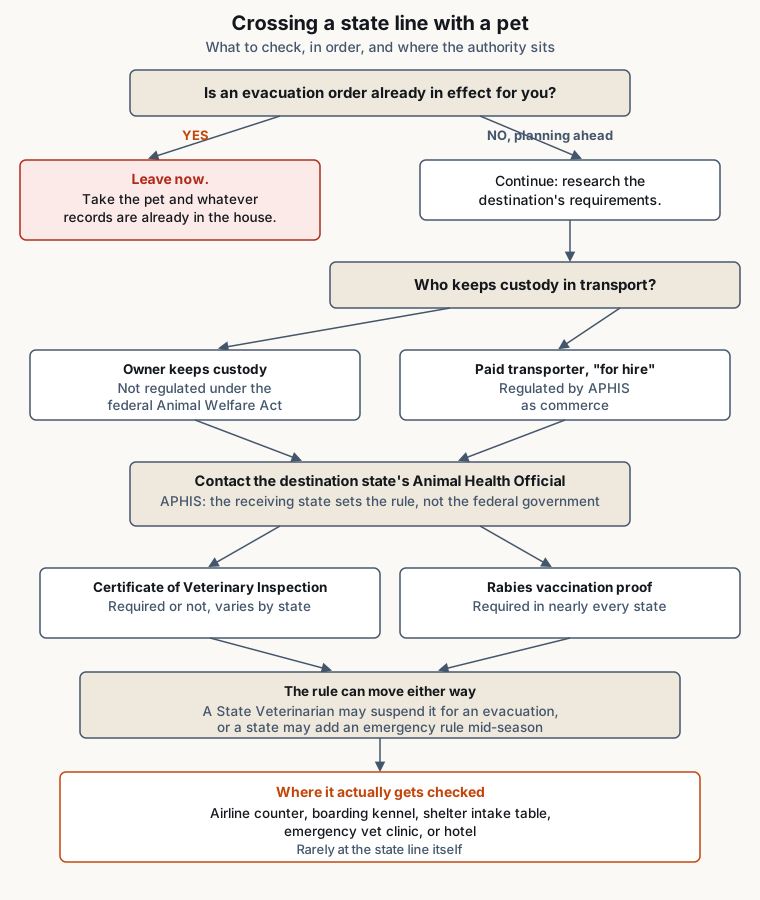
If an evacuation order is already out for you, leave on its schedule and read the rest of this from the road or from where you land. Ready.gov says: “If local officials ask you to evacuate, that means your pet should evacuate too. If you leave your pets behind, they may end up lost, injured or worse.” Take the animal, take whatever records are already in the house, and do not turn back at a state line over a document. The section on arriving with nothing is written for that case. Everything else is pre-season work.
This site does not publish its own reading of any state’s animal-entry rule. What follows is what named agencies published, with dates, and links back to each one.
The Federal Government Is Not the Authority Here
Most owners expect a federal answer, because a state line feels federal. APHIS’s interstate pet travel page, last modified June 10, 2026, says otherwise:
APHIS doesn’t regulate the interstate movement of pets by their owners. Domestic movement requirements are set by the receiving State or Territory.
The page adds that a destination may ask for a health certificate, updated vaccinations, diagnostic testing or treatments, and that you should contact your veterinarian as soon as you know your travel details. For questions, it sends you to the State animal health official for that State or Territory. APHIS links that phrase to the United States Animal Health Association’s State Animal Health Officials listing, the most useful bookmark on this page, because that office can answer the question for your animal, species and destination.
In an evacuation there is no single number to call. The rule that governs you is set by whichever state you cross into, and the state where you stop overnight has its own entry rule too.
Personally Owned Pet, or Pet in Commerce
Custody changes which federal law is in play, and evacuations are full of improvised hand-offs. APHIS’s page on transporting animals in commerce, last modified April 17, 2026, regulates any airline, motor carrier, rail carrier, shipping line or other business taking custody of AWA-regulated animals and transporting them “for hire”. Its examples include boarding kennels or hired drivers who take responsibility for shipping animals without the owner physically present. Those businesses must register with APHIS and meet its transportation standards.
On the other side, the same page says transportation of pets that remain in the custody of their owners is not regulated under the AWA. Its examples are pets in an aircraft cabin with their owner or the owner’s unpaid designee, and pets riding with their owner in a hired taxi. It closes with a caution: other Federal or State requirements may apply.
You driving your own dog is one situation. A neighbor driving your dog out because you are stuck at work is another. A paid pet-transport company moving your animal without you is a third, and it is the one where a business takes custody for hire. This page does not decide which category an arrangement falls into; that belongs to APHIS and the state. If your plan involves handing the animal to anyone who is paid, ask before the storm. Our emergency boarding checklist covers the questions to ask a facility.
Six States, Five Different Answers
Here is why this page has no fifty-state table. These six states are common evacuation destinations, each publishes its own rule, and between them they take five positions on whether a dog or cat needs a certificate. The table summarizes what each agency’s page said as of August 2, 2026.
| State and agency | Certificate for a dog or cat | Rabies |
|---|---|---|
| Texas DSHS | Not required for dogs and cats entering Texas. DSHS says no agency serves as a repository for CVIs for these species. | Dogs and cats 12 weeks or older must be vaccinated and carry a rabies vaccination certificate. To count as current, “30 days must have lapsed since the initial vaccination.” |
| Florida FDACS | An Official CVI within 30 days of issuance, “unless the pet is privately owned and traveling with its owner or meets an exception listed in Rule 5C-3.009, Florida Administrative Code” | Current vaccination if the pet is 3 months or older, with proof from a licensed veterinarian. |
| Georgia Department of Agriculture | Named only for pets entering for sale, trade or exchange for a fee or other compensation, and then issued within the previous 30 days. | All dogs and cats entering need proof of a current, approved rabies vaccination. |
| North Carolina DPH | ICVIs are no longer required for dogs, cats and ferrets entering the state. The page carries a December 16, 2019 update date. | The only requirement is a current rabies vaccination on entry, or a vaccination within one week of entry if of appropriate age, under NCGS 130A-185 and 130A-193. |
| South Carolina, Clemson Livestock Poultry Health | A CVI valid for 30 days, plus no exposure to or from an area under quarantine for rabies, plus a pointer to check Emergency Notices. | The owner must keep the pet inoculated against rabies, at a frequency that gives continuous protection, with a department-approved, USDA-licensed vaccine. |
| Tennessee Department of Agriculture | A CVI valid for 30 days if the animal is entering Tennessee for more than 15 days. | Current vaccination for dogs 3 months and cats 6 months of age. |
Two of the six publish no certificate requirement for a dog or cat. One names a certificate only when money changes hands. One requires it only when the stay runs past a stated number of days, which an evacuating family cannot predict on the day they leave. Florida requires it unless the pet is privately owned and traveling with its owner, which describes nearly every reader here. Only one lists a certificate with no such exception on the face of its page, and it also points to its emergency notices. The rabies column is where the states agree, and even there ages, waiting periods and wording differ.
The table does not cover the other forty-four states and territories, species other than dogs and cats, or anything a state did after August 2, 2026. Its job is to show variance. Pull your destination’s own page through the USAHA listing or the state selector on the APHIS interstate pet travel page.
The Florida exemption most owners never hear about
Florida receives and sends more pet evacuations than almost anywhere, so its rule text is worth reading in full. Florida Administrative Code Rule 5C-3.009, effective August 19, 2019, requires an OCVI for all dogs and cats imported into Florida, except four categories: dogs or cats imported only for exhibition that will stay less than six months, any Service Animal, any Working Dog, and any privately owned pets traveling with their owners. The OCVI must state that the animal is free from signs of any infectious or communicable disease, did not originate within an area under quarantine for rabies, and is not known to have a history of exposure to a rabies-infected animal before importation.
Whether your arrangement fits one of those categories is a question for the Florida State Veterinarian’s Office, whose number FDACS publishes on its movement page.
Then subsection (3) closes the door the exemption seemed to open. It requires proof of a current rabies vaccination for all dogs or cats three months and older transported into Florida, and says that group includes “privately owned pets traveling with their owners”. Within that one rule, the certificate and the vaccination are separate requirements, and the exemption in subsection (1) is not an exemption from subsection (3). Georgia’s page is arranged the same way. Two states are not a national pattern, but they are a reason to read your destination’s whole page, and a reason the most valuable paper in an evacuation go-bag is usually the rabies certificate. Our pet emergency binder guide builds the document set around it.
What a Certificate of Veterinary Inspection Actually Is
A CVI, written ICVI or OCVI in some states, is a document a veterinarian signs after examining an animal, stating what the destination requires it to state. It is different from a vaccination record. AVMA’s packing list treats them as two items: proof of vaccination, especially rabies, with relevant medical records, and a CVI if crossing state or international borders. A rabies tag on a collar is not the record either. Texas DSHS says documentation must be provided by a vaccination certificate, and lists the fields it must carry.
Two constraints make a CVI hard to get quickly.
Who may sign. AVMA says the certificate “needs to be signed by a federally accredited veterinarian, and not all veterinarians meet this requirement.” It advises calling ahead to ask whether your veterinarian is accredited or can refer you to someone who is. Accreditation runs through the USDA APHIS National Veterinary Accreditation Program, whose page carries a locator for accredited veterinarians. If your clinic is not accredited, the certificate is a referral to another practice, not a same-afternoon errand.
The clock. AVMA’s general guidance is a certificate issued within 10 days before air travel or, generally, within 30 days before any other type of travel. Treat that as orientation, because the destination state’s number controls and can be shorter. Florida’s movement page says most airlines require a certificate issued within seven to 10 days of travel, tighter than the state’s own window for a driving arrival.
A certificate obtained at the start of hurricane season is very likely expired when a storm threatens. If you are pre-staging documents, pre-stage the rabies certificate and vaccination history, which do not expire on a travel clock, and get the CVI close to departure if your destination requires one. Our comparison of why each records format fails differently covers paper against phone against cloud.
Who Can Change the Rule After You Looked It Up
The rule you researched in the quiet season can move in either direction before you use it. Both directions have live examples.
Loosening: a State Veterinarian can suspend requirements for an evacuation
On September 25, 2024, South Carolina State Veterinarian Michael Neault, who directs Clemson Livestock Poultry Health, announced a temporary suspension of some importation requirements for animals evacuating ahead of Tropical Storm Helene. The announcement said the state was “temporarily suspending some of the requirements governing the importation of agricultural and companion animals into South Carolina”, as in past storms. Four things in it matter more than the headline.
It was narrow. The release says: “The waivers apply only to animals evacuating from Florida and Georgia due to the storm.” A driver from a third state was not covered, in the same week, fleeing the same system.
It put a condition on the animals. Animals moving under the exceptions were “expected to return to their state of origin by Oct. 23, 2024” unless the order was extended or revised. South Carolina’s 2022 Hurricane Ian release, published September 26, 2022, used the same construction with an October 31, 2022 date. If you cross a line under a suspension, read what the order asks of you on the way home, and ask the issuing agency what happens if the date is not workable.
It did not suspend rabies. The 2024 release says the suspension did not suspend South Carolina law requiring cats, dogs and ferrets to be current on rabies vaccination. That is one order, in one state, in one storm, but it is a reason to carry the rabies certificate regardless.
It did not bind private businesses. Neault added that it was imperative for evacuees to verify that South Carolina facilities had room for their animals and were also waiving interstate movement requirements. A boarding kennel, a clinic offering overnight boarding and a hotel set their own admission conditions. Our pet-friendly hotel evacuation guide covers the property side of that gap.
One more point on where to look. As of August 2, 2026, Clemson Livestock Poultry Health’s Emergency Notices page listed only a 2019 vesicular stomatitis notice, while the storm suspensions of August 2021 (Ida), September 2022 (Ian) and September 2024 (Helene) were announced through the university’s news channel. If you are hunting for a live emergency order in South Carolina, check the news releases and phone the agency.
Tightening: a state can add requirements mid-season
The mirror case has been running since June 2026. FDACS’s New World Screwworm page first announced Emergency Rule 5CER26-7 (as of August 2, 2026). As of October 2, 2026, that notice was gone and the page said Florida Commissioner of Agriculture Wilton Simpson had issued emergency rules placing heightened restrictions on the importation of warm-blooded animals into Florida from high-risk areas and USDA- or state-designated infested zones. It names the rule now in force as 5CER26-15.
The Florida Administrative Code records show three emergency rules under one title, “Interstate Import Requirements for Warm-Blooded Animals Originating from Areas Impacted by New World Screwworm”: 5CER26-7, effective June 10, 2026; 5CER26-14, effective September 8, 2026; and 5CER26-15, effective October 1, 2026. The number changed twice in four months while the subject stayed the same, so anything you saved about 5CER26-7 describes an earlier text. What follows is from 5CER26-15.
The rule applies to warm-blooded domestic animals, not livestock alone. For animals originating outside an infested zone but from an infested state or a high-risk county, it requires an OCVI documenting inspection. The certificate must say that all animals listed on it have been inspected and are free from screwworm larvae infestation, and “The OCVI is valid for no more than 5 days from the date of inspection.”
For animals from an infested zone, the rule adds treatment with its own clock. Oral or injected treatments must be administered no fewer than 12 hours and no more than 14 days before entry into Florida. Systemic, topical treatments must be given no fewer than 72 hours and no more than 14 days before entry. Treatment must be administered by or directly overseen by an authorized representative, a term the rule defines to include a USDA-accredited veterinarian authorized to conduct animal disease control and eradication activities. The rule also requires an FDACS Certificate of Animal Movement with a prior permission number requested a minimum of two business days in advance of the importation date. An evacuation compresses exactly those clocks: a 72-hour minimum on a systemic topical product is three days you may not have once an order is issued.
Read the definition before deciding an infested zone is not your problem. The rule treats an animal as originating from an infested zone if it is moving from one or has been present in an infested zone within the previous fourteen days. Once an infested zone is declared free of screwworm, the fourteen-day timeframe no longer applies, and animals transported through an infested zone without stopping or offloading are not treated as originating from one. The rule also says “No shelter animals originating from an infested state may be imported into Florida.”
FDACS’s page dates its own county lists as of October 2, 2026. Infested-zone counties are Grant County, New Mexico and twelve Texas counties: Brewster, Crockett, Edwards, Jeff Davis, Pecos, Presidio, Schleicher, Starr, Sutton, Terrell, Val Verde and Zapata. High-risk areas cover ten Arizona counties, four California counties, and every New Mexico and Texas county not on the infested list. On August 2, 2026 the lists were dated July 20 and June 16; as of October 2 both carried that day’s date. Those lists are the part most likely to have moved by the time you read this.
It has teeth. Subsection (4), headed “Penalties for Non-Compliance”, opens: “Animals originating from an infested zone will be refused entry into Florida.” It goes on to say animals from a high-risk county or an infested state will be quarantined to destination, and animals found to have unlawfully entered Florida from a high-risk county, an infested state or an infested zone without complying will be quarantined. The subsection also sets administrative fines per animal and per load; the figures are in the rule text, and this site does not publish fine amounts. How that penalty language sits against subsection (2), which describes a route into Florida for treated animals from an infested zone, is a question for the Florida State Veterinarian’s Office. For route planning, what matters is that refusal of entry and quarantine are both written into a live rule.
South Carolina published its own, different screwworm movement requirements over the same period. For companion animals from an infested zone, Clemson Livestock Poultry Health’s page describes an accredited-veterinarian inspection, two permit request forms submitted at least forty-eight hours before movement, an ICVI issued within five days of inspection carrying a specified statement, and a pre-entry treatment recorded on the permits and the certificate. Two states, one outbreak, two sets of paperwork.
This page does not say how Florida’s emergency rule interacts with the standing exemption for privately owned pets in Rule 5C-3.009. The emergency rule’s exemptions section, as of 5CER26-15, names dairy calves from an infested zone that have had specified treatments, certain poultry, small mammals “originating from an infested zone that are born and raised indoors”, and, from parts of the treatment requirement, cattle consigned directly to a slaughter establishment regulated under the Federal Meat Inspection Act. It does not name privately owned pets traveling with their owners. Whether that silence changes anything for a family driving a dog out of an affected county is a question for the Florida State Veterinarian’s Office.
Two currency points. First, the affected-area lists carry their own as-of dates, and a list with an as-of date is a list that changes. Second, Florida Statute 120.54(4)(c)1 says an emergency rule “may not be effective for a period longer than 90 days and may not be renewable”, except when the agency has initiated rulemaking on the subject and either a challenge to the proposed rules is pending or the proposed rules await ratification by the Legislature. If the proposed rule is not ratified in the next regular session, the emergency rule expires at adjournment sine die. Ninety days from 5CER26-7’s June 10, 2026 effective date was September 8, 2026, the effective date the Florida Administrative Code record shows for 5CER26-14, and 5CER26-15 followed effective October 1, 2026. Whether the statute’s exception applies and how long the current rule runs are questions for the Florida Administrative Code record and the FDACS screwworm page. Check both before acting on any of it.
Where the Requirement Is Actually Enforced
Owners assume this does not matter because they have crossed state lines with a dog and nobody stopped them. That experience is real, and it is a bad guide to the risk. Texas DSHS says no agency serves as a repository for CVIs for dogs and cats, so in the routine case nobody is reading your dog’s file at the state line.
That is the routine case, not the whole picture. Florida’s screwworm rule provides for animals from an infested zone to be refused entry and for non-compliant animals to be quarantined, a border consequence written into the rule FDACS named as in force on October 2, 2026. A disease emergency is the situation that turns a rarely checked requirement into a checked one, and an evacuation season can produce it.
The asking happens at counters with their own reasons to care:
- An airline counter. Florida’s movement page and Texas DSHS both note that airlines commonly require a certificate within seven to ten days of travel, even where state law requires none. If your evacuation involves a flight, the airline’s window is likely the tightest you face. Our airline-approved carrier guide covers the hardware half of that counter.
- A boarding kennel or a veterinary clinic taking a boarder. Private facilities set their own admission conditions, which is why South Carolina’s State Veterinarian told evacuees to confirm facilities were also waiving requirements.
- A county pet shelter intake table. Pinellas County’s preparedness page lists “Immunization records from your vet” and the “License tag and form received after rabies vaccination” among basic pet supplies.
- An emergency veterinary clinic at the destination, which works from whatever record you can produce.
- Some hotels and rental properties, which increasingly ask for vaccination proof as a condition of a pet policy.
None of those is the state line, and all are on the route. The cost of missing a requirement lands when you most need someone to take your animal.
The Shelter Door and the State Line Ask Different Questions
A state entry requirement is about disease control across a border and is set by an animal health agency. A shelter intake requirement is about housing many animals together safely for a few days and is set by a county. They can demand different documents, answer to different offices, and satisfying one tells you nothing about the other.
Our guide to what pet-friendly disaster sheltering actually looks like covers the shelter half. Two spokes answer the questions this section separates: the document-by-document version of a shelter intake check and which animals a county pet shelter refuses and on what grounds. Our state-by-state directory of official emergency-management pet pages points at the sheltering side of each state government, a different agency from the animal health official this page sends you to. In an evacuation you usually need both answers on the same night.
The Species That Get Caught
Dog and cat owners have the easiest version of this question, because state pages are written for them first. Everyone else finds their rule further down the page or on a different page.
Birds. Georgia’s Department of Agriculture says all exotic or pet birds entering Georgia for any purpose require a prior permit number from the Animal Health Section in Atlanta, Georgia, and lists (404) 656-3667. A permit obtained during business hours is not something you produce at midnight with a warning out. The same page lists the Java Rice Bird and the Quaker or Monk Parakeet among birds “restricted from entry into Georgia except by special permit from the State Veterinarian.” If you keep a parrot, find your destination’s bird rule before the season. Our bird and parrot emergency preparedness guide covers the rest of the species-specific plan.
Ferrets. Georgia requires rabies vaccination proof for ferrets, and says ferrets seven months or older entering Georgia must be spayed or neutered before entry, except those exempted by a license or permit issued by USDA APHIS Animal Care or the Georgia Department of Natural Resources. South Carolina lists ferrets on the same import page as dogs and cats, with a certificate and rabies vaccination. North Carolina groups ferrets with dogs and cats in dropping its certificate requirement. Three states, three postures. Our ferret emergency kit guide covers the supply side of the trip.
Small mammals, meaning rodents and rabbits. Under Florida’s screwworm rule, 5CER26-15 as of October 2, 2026, small mammals “originating from an infested zone that are born and raised indoors” are exempt from subsection (2) but must otherwise meet the testing and movement requirements in Chapter 5C-3, F.A.C., and must still carry an OCVI with the specified inspection statement. An exemption that still requires a document is not an exemption from the vet visit. Check the definition: the rule defines small mammals as animals in the order Rodentia or Lagomorpha, which is rodents and rabbits. A ferret is in neither order, so the ferret paragraph above applies to a ferret.
Poultry and backyard flocks sit under a separate regulatory system, often with permits and disease-control overlays unrelated to pet rules. Our backyard chicken evacuation guide covers the logistics, and the movement question belongs to the destination state’s animal health official.
Horses and livestock are the animals the interstate movement system was built around, with tests, official identification and certificate requirements that pets rarely face. Our horse and livestock evacuation basics covers the paperwork that travels with a horse.
Island and territory destinations can run quarantine regimes stricter than anything here, with steps that happen before departure. Take that question to the jurisdiction’s own agency well ahead of time.
The Honest Answer About Arriving With Nothing
Plenty of readers are already on the road with a dog in the back seat and no folder. Keep going. Missing documents are not a reason to turn back toward a storm, and Ready.gov’s instruction runs the other way. What follows is a list of calls to make once you are somewhere safe.
The published requirement does not disappear because you left in a hurry. No agency page read for this article creates a general disaster exemption from state entry rules. What exists are dated, state-specific suspensions issued by a State Veterinarian for a named storm, like South Carolina’s: limited by origin, carrying a return-by expectation, and in the 2024 case saying it did not suspend the rabies requirement.
A few states publish accommodations in their standing text. North Carolina’s Division of Public Health says ICVIs are no longer required for dogs, cats and ferrets, and that the only requirement is a current rabies vaccination on entry or a vaccination within one week of entry if of appropriate age, under NCGS 130A-185 and 130A-193. That is North Carolina’s own rule, on a page carrying a December 16, 2019 update date, and you cannot carry it into any other state.
Read the two statutes before you plan around it, because vaccinate-on-arrival comes with a confinement period. NCGS 130A-185(a) requires the owner of a cat, dog or ferret over four months of age to have the animal vaccinated against rabies. NCGS 130A-193(a) says an animal brought into the state that is required to be vaccinated “shall immediately be securely confined and shall be vaccinated against rabies within one week after entry”. It adds: “The animal shall remain confined for two weeks after vaccination.” Two weeks of confinement is a different proposition in a hotel room, at a relative’s house, or if you plan to keep moving. Subsection (b) then lists exceptions to subsection (a), including an animal brought in with a veterinarian-issued certificate showing it is apparently free from and not exposed to rabies and is currently vaccinated. This page does not say which provision reaches your animal; that is the North Carolina Division of Public Health’s call, and the statutes are linked in the sources.
So do not guess whether you are covered. Do four things on arrival:
- Call the destination state’s animal health official. Find the office through the USAHA State Animal Health Officials listing. Give the species, where you came from, and that you are displaced.
- Book a veterinary appointment where you land. A local, federally accredited veterinarian can vaccinate, examine and issue a certificate if the state requires one, so ask about accreditation on the phone. Ask about the clock too, because a vaccination given on arrival does not always make an animal compliant that day. Texas’s rule adds that if an initial vaccination was given less than 30 days before arrival, “the custodian should confine the dog or cat for the balance of the 30 days.” North Carolina attaches two weeks of confinement after vaccination to an animal required to be vaccinated under its statute. Ask what your destination’s rule is, and whether an exception applies to your animal.
- Ask your own practice to send the record. Your veterinary practice holds the vaccination history whether or not you carried a copy, and a call or email often produces a usable record the same day.
- Write down what you were told and by whom. You will be asked the same question by a kennel, a clinic and possibly a shelter. A name, a date and an agency saves you re-arguing it at every counter.
None of that is a license to travel undocumented on purpose. It is the recovery route for someone already moving.
Moving, Not Evacuating: The Same Question With Lead Time
A planned move has the same legal question and a calendar to work with. The destination state still sets the rule, and APHIS still sends you to the state animal health official, so call that office instead of assuming your origin state’s rules travel with you.
- As soon as you have a move date, schedule a veterinary exam. AVMA’s general travel guidance is to confirm your pet is healthy and current on vaccines, rabies specifically, before an interstate trip. Ask then whether your destination requires a CVI.
- Update the microchip registry when you have a move date and again once you are settled, per AAHA. When someone brings a found pet to a hospital or shelter, the team scans for a chip first, and a chip linked to a dead phone number or old email reaches no one. AAHA’s lookup tool identifies which registry holds the record; the update itself happens at that registry.
- Start carrier or crate acclimation early, in the weeks before the move, per the ASPCA’s moving guidance.
- Time the CVI to the window. AVMA’s general timing is within 10 days before air travel or, generally, within 30 days before other travel, from a federally accredited veterinarian. The destination state’s window controls and can be shorter, so confirm it with that state’s office.
- Collect the vaccine records and any prior CVIs into one waterproof set. Our waterproof pet document kit guide and pet emergency binder cover what to include and how to protect it. Our pet travel and relocation document organizer is a fill-in sheet for the certificate and rabies dates, the destination vet and a pre-trip checklist.
Moving: Safety on a Multi-Day Drive
The certificate is one part of a long-distance move. These points come from AVMA, the ASPCA, VCA Animal Hospitals and Aqueon, and the cat-hotel point comes from a pet-travel specialty site, not a veterinary body.
- Restrain every animal. AVMA’s policy on non-commercial pet transport says pets should not ride loose in a vehicle. Each needs a secured, size-appropriate, ventilated crate or carrier, or a properly designed harness, for the whole trip. The distance does not relax the rule. Our vehicle loading and restraints guide covers the setup.
- Stop every two hours, per AVMA, so dogs can exercise and relieve themselves. Keep cats in their carrier at rest stops instead of letting them out.
- Feed light. AVMA recommends small portions of food and water on the road rather than full meals. The ASPCA says to feed 3 to 4 hours before departure, not to feed in a moving vehicle, and to use bottled water or water brought from home.
- Never leave a pet alone in a parked car, at any stop, for any reason, per the ASPCA. Heatstroke risk does not need a hot day or a long absence, and cracking the windows does not meaningfully change it.
- Sedation is a question for your veterinarian. AVMA’s documented caution is specific to air travel: sedatives and tranquilizers are generally not recommended there because of risks to heart and respiratory function, temperature regulation and balance. AVMA says a veterinarian may judge tranquilization appropriate for an individual pet. No AVMA statement on sedation for a car trip is cited here, so raise it with your veterinarian before the move. This page names no drug or dose.
- Hotel nights. Confirm the pet policy for every planned stop, since a policy that suits a small dog may exclude cats, birds or exotic pets. A pet-travel specialty source says never to let a cat roam a hotel room, because there are too many places to get stuck or hidden: confine it to the bathroom with food, water and a litter box at every stop. Keep the same door-and-carrier discipline at a hotel that you keep in the car.
- Birds. VCA says to use a small cage or a commercial bird travel carrier with perches and food cups, never let the bird roam loose in the car, secure the carrier with a seatbelt, and remove hanging toys before transit. In cold weather, pre-warm the car and cover the carrier with a towel or blanket. In hot weather, ensure real ventilation and never leave the bird unattended in the car. Skip open water bowls in transit; VCA suggests moist fruit or vegetables between stops and water at rest stops. Our bird and parrot emergency preparedness guide covers the fume hazard at home and on the road.
- Fish. For a short local move, Aqueon’s guide describes bags filled one-third water and two-thirds air (or half water and half pure oxygen), double-bagged and laid on their side, with larger fish in buckets holding about 75 to 80 percent of the existing tank water. For a cross-country move Aqueon offers no DIY method: it recommends re-homing the fish and buying new ones after you settle, or asking a local fish store about boarding or specialist overnight shipping. For an evacuation, see transporting fish during a hurricane.
- Reptiles. Temperature and life-support needs do not pause for a long drive. Plan the temperature method before you leave and call an exotics-capable veterinarian if your species and trip length have no clear answer. Our aquarium and reptile power outage guide covers heat packs, insulation and the limits of both.
- Ferrets. If the move ends in California or Hawaii, check state law first: both states restrict the species. Our ferret emergency kit guide covers it.
- Any pet with a condition that complicates confinement or a long car ride (severe anxiety, orthopedic problems, breathing difficulty in a flat-faced breed): ask your veterinarian about the specific trip plan well before moving day.
Prepare This Before the Season, Not During the Warning
Handled while nothing is happening, this takes a single sitting.
Identify your realistic destinations, then look up their rules. Not every state: the two or three you would drive to, plus any state you would pass a night in. Pull each page from the APHIS state selector or the USAHA listing, and save the link and phone number.
Get a current rabies certificate for every animal, in your hands. Not the tag. Texas’s rule lists what a state expects the certificate to show: the vaccination date, the vaccine used, the revaccination due date, identification of the animal, the custodian’s contact information, and the vaccinating veterinarian’s signature and contact information. If your copy lacks any of that, ask your clinic for a replacement now. If the clinic has closed or been destroyed, the fallback chain for recovering a record when the practice is gone works through who else holds a copy.
Ask your veterinarian whether they are federally accredited. One question at a routine appointment decides whether a certificate is a same-week task or a referral.
Decide the format, then build it. Waterproof paper that survives a wet counter, phone photos that open without signal, and a copy someone else can reach.
Write the species line into your plan. If you keep a bird, ferret, reptile or flock, the dog and cat answer is not yours.
Calendar a re-check. Rules move and emergency rules expire. A note at the start of each season to re-pull the destination pages costs ten minutes and is the only defense against the failure this page keeps illustrating.
For the surrounding plan, our pet evacuation kit guide covers what travels with the animal, and the hurricane preparedness playbook covers the timeline the documents have to fit inside.
What This Page Will Not Tell You
This is not legal advice. Animal-entry rules are state-specific, species-specific and revisable inside a single hurricane season. This page does not tell you whether your animal qualifies for any exemption quoted above, whether an arrangement counts as transport for hire, how any emergency rule interacts with a standing exemption, whether a return-by condition in a past suspension would bind you under a future one, how a confinement period would be counted for your animal, or what a state will do if you arrive without a document. Those determinations belong to the destination state’s animal health official, to USDA APHIS where federal transport rules apply, and to your own federally accredited veterinarian.
Where to Go Next
- Still deciding where you and the animal will sleep? Start with whether pet-friendly disaster shelters exist and what they require.
- Crossing a state line because your county has nothing to offer or has filled? See when your county has no pet-friendly shelter, which decides which state you end up needing to look up.
- Deciding how to carry the records? Read why paper and phone copies fail in opposite ways.
- Handing the animal to a facility? Work through the emergency boarding checklist and the decision on boarding versus evacuating together.
- Traveling in an RV? The paperwork rides differently; our RV pet emergency checklist covers where it lives on board.
Frequently asked questions
Do you need a health certificate to cross state lines with a pet?
It depends on the state you drive into. APHIS says it does not regulate owners' interstate pet moves, and that the receiving State or Territory sets the requirements, which may include a health certificate, vaccinations, testing or treatments. The same holds whether you are evacuating or moving. Ask the destination state's animal health official, found through the USAHA State Animal Health Officials listing, and your own veterinarian.
Does the rabies requirement go away if the certificate does not apply to me?
Not in the state rules read for this page. Florida's Rule 5C-3.009 exempts privately owned pets traveling with their owners from the certificate, then requires proof of a current rabies vaccination for all dogs and cats three months and older, including those pets. Georgia requires a certificate only for pets entering for sale, trade or compensation, and requires rabies proof for all dogs and cats entering.
Can a state waive pet entry rules for an evacuation, or tighten them mid-season?
Both have happened. South Carolina suspended some animal import requirements for Helene in September 2024, for animals evacuating from Florida and Georgia only, with a return-by date, and without suspending rabies. Florida issued three screwworm emergency rules in four months: 5CER26-7, 5CER26-14 and 5CER26-15, effective October 1, 2026. A past order shows the mechanism exists, not what is in force tonight.
Who can sign a pet health certificate, and how long is it good for?
AVMA says a certificate must be signed by a federally accredited veterinarian, and not all veterinarians are. It points to a certificate issued within 10 days before air travel or, generally, within 30 days before other travel. The destination state's window controls and can be shorter: Florida's screwworm rule allows 5 days from inspection. Ask your clinic whether it is accredited before you need the paper.
What happens if I evacuate across a state line with no paperwork?
The published requirement does not disappear, but it is not a reason to stay put or turn back. Leave with the animal, then call the destination state's animal health official, book a veterinarian where you land, and ask your own practice to send the vaccination record. Ask about waiting and confinement periods: Texas says 30 days must pass after an initial rabies vaccination. This is a recovery route, not clearance to travel undocumented.
Does anyone actually check a pet health certificate at a state line?
Usually not at the line. Texas DSHS says no agency serves as a repository for CVIs for dogs and cats. Documents are asked for at airline counters, boarding kennels, county pet shelter intake, emergency vet clinics and some hotels. A disease emergency can change that: Florida's screwworm rule provides for refusing entry to animals from an infested zone. A rule rarely checked at a road sign is still the rule.
Free checklist
Get the printable pet go-bag checklist by email
A one-page, print-ready go-bag checklist grouped by Ready.gov, ASPCA, AVMA, CDC and Red Cross categories, with a link to the full guide for per-animal quantities. One email to confirm it's you, then the checklist, the binder templates and occasional new guides. Unsubscribe any time.
Sources
We are not veterinarians, and we would rather you check these than take our word for anything. These are the sources this page relies on. For your own animal, your vet is the expert, not this page.
- USDA APHIS: Take a Pet From One U.S. State or Territory to Another (Interstate), last modified June 10, 2026 (opens in a new tab)
- USDA APHIS: Transporting Animals in Commerce, last modified April 17, 2026 (owner custody versus transport for hire) (opens in a new tab)
- USDA APHIS: National Veterinary Accreditation Program, last modified June 4, 2026 (locator for accredited veterinarians) (opens in a new tab)
- AVMA: Traveling with your dog or cat (CVI timing, federally accredited signature, packing list) (opens in a new tab)
- USAHA: State Animal Health Officials listing (opens in a new tab)
- Florida Department of Agriculture and Consumer Services: Dog and Cat Movement Requirements (opens in a new tab)
- Florida Administrative Code Rule 5C-3.009, Dogs or Cats (effective August 19, 2019) (opens in a new tab)
- Florida Emergency Rule 5CER26-15, Interstate Import Requirements for Warm-Blooded Animals Originating from Areas Impacted by New World Screwworm (effective October 1, 2026) (opens in a new tab)
- Florida Emergency Rule 5CER26-14, same title (effective September 8, 2026 per the Florida Administrative Code record) (opens in a new tab)
- Florida Emergency Rule 5CER26-7, same title (effective June 10, 2026 per the Florida Administrative Code record) (opens in a new tab)
- FDACS: New World Screwworm (names 5CER26-15 as the current emergency rule; county lists dated October 2, 2026) (opens in a new tab)
- Florida Statutes 120.54, Rulemaking (emergency rule duration) (opens in a new tab)
- Texas DSHS: Animal Import and Export Requirements (opens in a new tab)
- Georgia Department of Agriculture: Bringing Animals into Georgia (opens in a new tab)
- North Carolina Division of Public Health: Import/Export Requirements for Dogs, Cats and Ferrets (page updated December 16, 2019) (opens in a new tab)
- North Carolina General Statute 130A-185, Vaccination required (opens in a new tab)
- North Carolina General Statute 130A-193, Vaccination and confinement of animals brought into this State (opens in a new tab)
- Tennessee Department of Agriculture: Animal Import Requirements (opens in a new tab)
- Clemson Livestock Poultry Health: Canine, Feline and Ferret Import Requirements (opens in a new tab)
- Clemson Livestock Poultry Health: New World Screwworm Animal Movement (opens in a new tab)
- Clemson Livestock Poultry Health: Emergency Notices (opens in a new tab)
- Clemson News: South Carolina suspends some animal interstate transport requirements due to Tropical Storm Helene (2024) (opens in a new tab)
- Clemson News: South Carolina suspends some veterinary requirements to facilitate animal evacuations due to Ian (2022) (opens in a new tab)
- Clemson News: South Carolina suspends some veterinary requirements to facilitate animal evacuations ahead of Ida (2021) (opens in a new tab)
- Pinellas County: Preparing Pets for Emergencies (opens in a new tab)
- Ready.gov: Pets and Animals (opens in a new tab)
- AVMA: Traveling with your animal (stops every two hours, small portions of food and water) (opens in a new tab)
- AVMA: Safe non-commercial transport of pets in motor vehicles (policy) (opens in a new tab)
- ASPCA: Moving With Your Pet (carrier acclimation) (opens in a new tab)
- ASPCA: Road Trip Tips for You and Your Pet (feeding before departure, never leave a pet in a parked car) (opens in a new tab)
- AAHA: How to Update Microchip Details (opens in a new tab)
- AAHA: Microchip Registry Lookup Tool (opens in a new tab)
- VCA Animal Hospitals: Transporting Your Bird (opens in a new tab)
- Aqueon: How to Move an Aquarium (opens in a new tab)
- Traveling With Your Cat: How to Hide a Cat in a Hotel (a pet-travel specialty site, not a veterinary body) (opens in a new tab)
Related reading
Shelter Guide
Do Pet-Friendly Disaster Shelters Exist, and What Should You Expect?
Comparison
Paper vs Digital Pet Medical Records for Evacuation: The Honest Answer
Checklist
The Pet Emergency Binder: Build It Once
Buying Guide
Pet Emergency Documents: What to Keep, and the Waterproof Kits to Store Them In